Introduction: mailbox-first ABM is a response strategy
ABM is simple in theory:
- pick the right accounts
- run coordinated touches
- convert attention into meetings and pipeline
In practice, ABM often becomes:
- more outbound noise
- more “personalized” emails that feel the same
- more dashboards with unclear causality
Mailbox-first ABM is a different posture:
- assume inbox attention is scarce
- use mail as a high-leverage response layer
- orchestrate email, calls, and ads around it
- measure pipeline impact with cohorts and holdouts
If you want background on why mail works for B2B sales, see: How direct mail makes an impact for B2B sales.
Step 1: define your tiering model (the ABM “budget allocator”)
Mailbox-first ABM only works if you’re selective.
Example tiers:
- Tier 1 (whales): 20–200 accounts — handwritten notes/letters
- Tier 2: 200–2,000 accounts — hybrid (printed reach + selective handwritten)
- Tier 3: 2,000+ accounts — digital only (mail only on high-intent signals)
Use a tiering input set:
- ACV/LTV potential
- strategic fit
- intent/engagement
- sales capacity
Format selection deep dive: Printed vs Handwritten vs Hybrid Direct Mail: The 3‑Tier Format Selector for B2B.
Step 2: choose triggers (mail should be signal-based)
Good triggers:
- demo booked or completed
- stakeholder added (multi-threading)
- late-stage stall
- event attendance
- high-intent engagement (webinar + site activity)
For the RevOps build, use the HubSpot and Salesforce direct mail workflow guide to turn those ABM triggers into guarded CRM automations.
Avoid “calendar mail” unless it’s a proven program (e.g., annual exec touch to top accounts).
Cadence companion: Using Direct Mail with Multi-Touch Campaigns & Optimizing ABM Cadence.
Step 3: build 3 core sequences (copy + timing)
Sequence A: Tier 1 outbound (warm-ish)
Trigger: intent/engagement threshold hit Goal: convert interest into a meeting
- Email (short, relevant)
- Handwritten note (1 personalization line + clear CTA)
- Email follow-up (“did it land?”)
- Call + voicemail
Sequence B: post-demo acceleration
Trigger: demo completed Goal: maintain momentum and multi-thread stakeholders
- recap email with next steps
- handwritten note referencing one key point
- email to include stakeholder(s)
- exec sponsor letter for Tier 1 if needed
Sequence C: late-stage unstick
Trigger: opp stalled 14–30 days Goal: restart conversation with seriousness
- short email “what changed?”
- handwritten note/letter from AE or exec sponsor
- call + calendar invite to re-align
Step 4: copy framework (what to write)
Mailbox-first ABM notes work when they’re:
- short
- specific
- tied to a real signal
- measured against pipeline outcomes
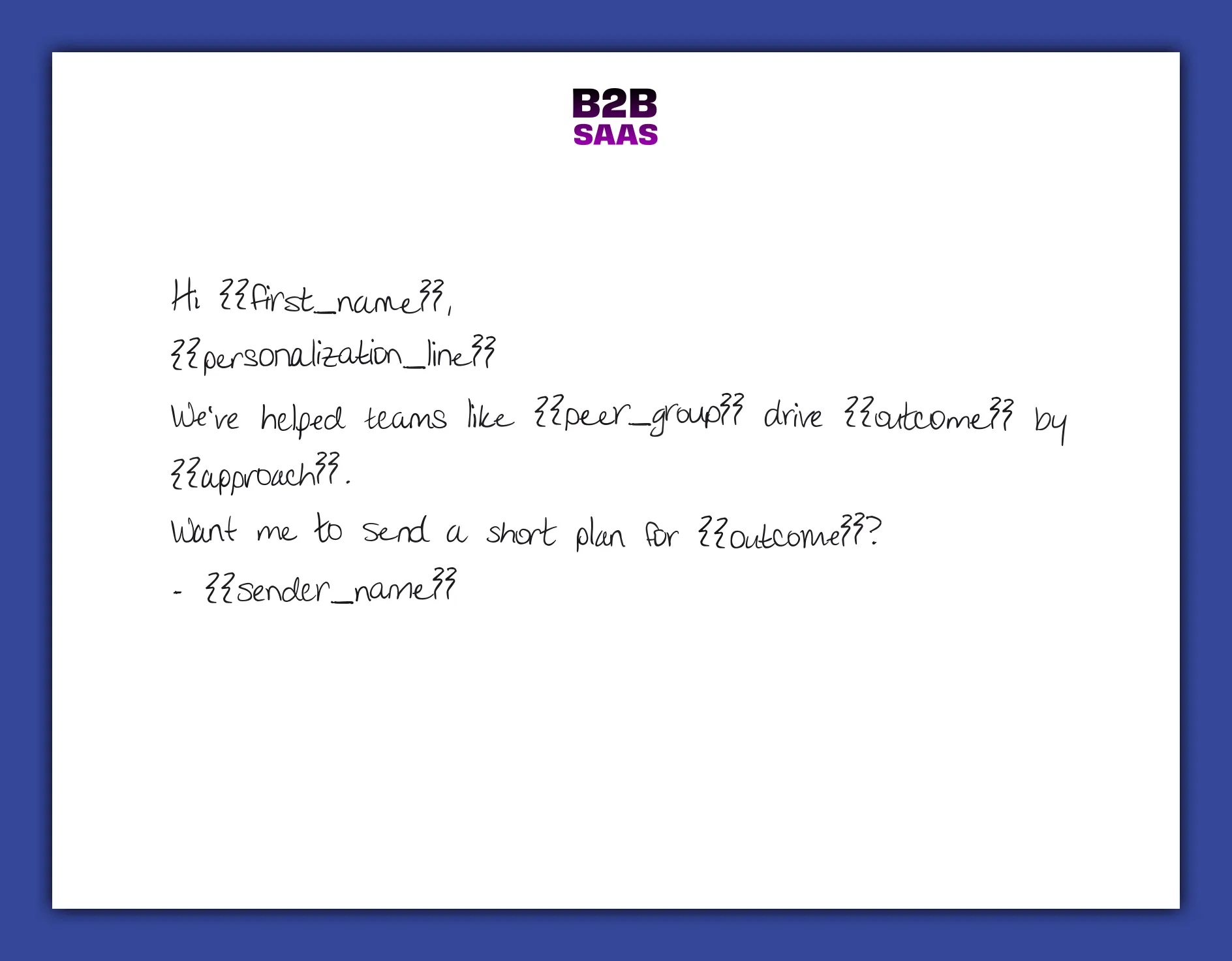
Template: Tier 1 ABM note
Hi {{first_name}}, {{personalization_line}} We’ve helped teams like {{peer_group}} drive {{outcome}} by {{approach}}. Want me to send a short plan for {{outcome}}? — {{sender_name}}
If you want a library of thank you notes and relationship templates, see: Business Thank You Notes: 25+ Templates for Clients, Prospects & Partners.
Step 5: ops and data (what makes or breaks execution)
Mailbox-first ABM needs:
- validated addresses (especially with remote work reality)
- clean segmentation (tier, persona, trigger)
- frequency caps (avoid over-mailing)
- QA gates for personalization (no creepiness)
List hygiene guide: B2B Mailing Lists that Convert: Enrichment, Hygiene, and Compliance.
Step 6: measurement (pipeline-first)
Don’t measure ABM mail like eCommerce mail.
Primary metrics:
- replies
- meetings booked
- opportunities created
- stage velocity
- win rate (over longer windows)
Measurement mechanics:
- log mail touches in CRM
- trackable URLs/QRs for CTAs
- matchbacks by cohort
- holdout tests for lift
Attribution deep dive: Direct Mail Attribution for B2B.
Step 7: scaling without losing relevance
Mailbox-first ABM scales via:
- templates with one-line personalization
- upgrading only engaged Tier 2 accounts to handwritten
- using enrichment workflows (e.g., Clay) with QA gates
Implementation guide: Clay + Scribeless for ABM.
Conclusion
Mailbox-first ABM is not “send more stuff.”
It’s a disciplined system:
- tier accounts
- trigger mail by signal
- keep copy short and specific
- orchestrate channels around mail
- measure pipeline impact with cohorts and holdouts
For the product layer, see Scribeless as a handwritten direct mail platform for ABM.
Want help building a mailbox-first ABM program (tiering, triggers, templates, measurement)? Book a campaign consult