Introduction: the GTM engineer’s direct mail workflow
ABM teams want two things that seem to conflict:
- real personalization
- operational scalability
Clay is great for enrichment and workflow automation. Scribeless is built for sending handwritten mail at scale.
Together, they let you build an ABM motion where mail is:
- triggered and segmented
- personalized in a controlled way
- measured back to pipeline outcomes
This guide is a practical implementation outline. For Clay-specific walkthroughs, these are useful references:
- Claymation: https://www.claymation.io/p/clay-scribeless-automate-personalized-handwritten-letters-postcards-for-abm-campaign
- Clay University: https://university.clay.com/claybooks/create-personalized-handwritten-letters-in-bulk
- Scribeless Clay integration doc: https://help.scribeless.co/en/articles/8985575-clay-integration
What you’ll build
At the end, you’ll have:
- a Clay table of target accounts/people with validated addresses
- a safe personalization field (one “why you / why now” line)
- a Scribeless campaign template using variables
- a reliable send step (API/integration) with QA gates
- a measurement trail in your CRM
Step 1: define your ABM “send criteria” (don’t skip this)
Before you touch automation, define:
- ICP and tiering (Tier 1 vs Tier 2)
- triggers (intent, engagement, stage movement)
- frequency caps (avoid over-mailing)
If you want the strategic baseline, see: Using Direct Mail with Multi-Touch Campaigns & Optimizing ABM Cadence.
Step 2: build your Clay table (minimum columns)
Recommended columns:
- first_name
- last_name
- role/title
- company
- company_domain
- country
- full_postal_address
- account_tier (1/2/3)
- trigger_reason (why now)
- personalization_line (one sentence)
- scribeless_template_id / campaign_id (optional)
- send_status (queued/sent/held)
- last_sent_date
Step 3: enrich and validate addresses (this is where most workflows fail)
Rules of thumb:
- never send without country + postal code
- add an “address confidence” field (verified/likely/unknown)
- for Tier 1, do a manual spot-check (10–20 records)
For broader list hygiene guidance: B2B Mailing Lists that Convert: Enrichment, Hygiene, and Compliance.
Step 4: generate personalization safely (“one line” method)
The goal is not to write a novel. It’s to create one high-signal line that proves relevance.
The one-line prompt pattern (example)
Inputs:
- role, company, industry
- one public signal (job post, announcement, product page)
- your value hypothesis
Output:
- one sentence that passes the “receipt test”
Good examples:
- “Noticed you’re hiring SDRs in {{region}}—teams often hit a deliverability wall right as volume ramps.”
- “Your launch around {{feature}} is a smart wedge; most teams struggle most with follow-up once interest spikes.”
Avoid:
- anything that reveals private tracking
- anything overly specific without a public source
- generic flattery (“love what you’re doing”)
For more on personalization workflows: Leveraging Technology: Personalization & Data Driven Campaigns.
Step 5: create a Scribeless template with variables
Keep your note short and structured.
Example variable layout:
- greeting + name
- 1 personalization line
- 1 value line
- 1 low-friction CTA
Example:
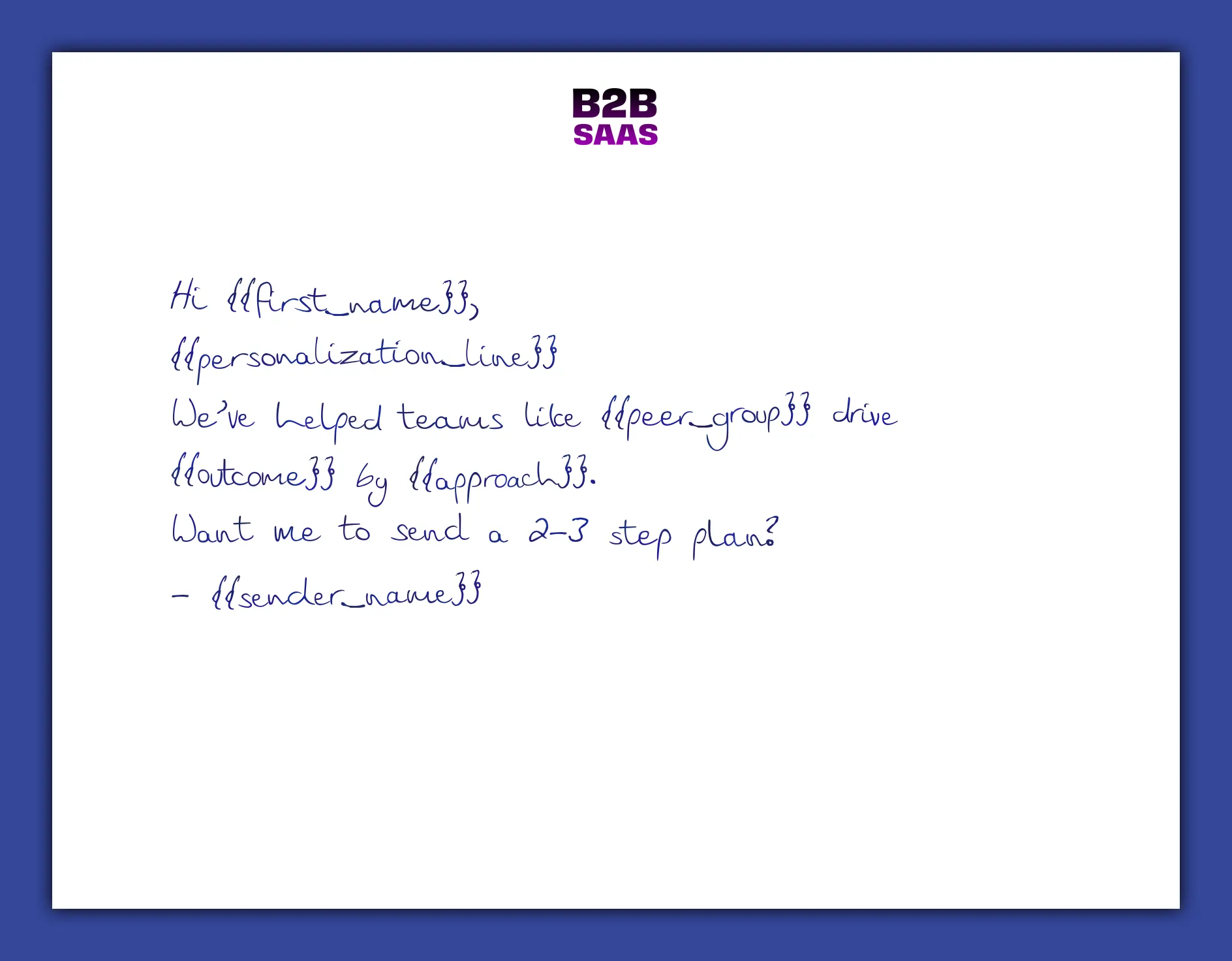
Hi {{first_name}}, {{personalization_line}} We’ve helped teams like {{peer_group}} drive {{outcome}} by {{approach}}. Want me to send a 2–3 step plan? — {{sender_name}}
Step 6: add QA gates (before any API send)
At minimum:
- block sends if address missing/unknown
- block sends if personalization_line is empty
- block sends if any variable is unresolved
- sample review: manually review 20–50 notes before scaling
Step 7: send in batches and throttle
Start small:
- Tier 1: 25–100 sends
- measure outcomes for 2–4 weeks
- iterate copy + selection criteria
Throttle rules:
- cap per account per month
- cap per persona per quarter
Step 8: measure impact in the CRM (pipeline-first)
Don’t optimize for vanity metrics.
Track:
- replies and meetings booked
- opportunity creation rate
- stage progression speed
- win rate (for late-stage motions)
Minimum instrumentation:
- log mail sent date in CRM
- add campaign_id / template_id fields
- use trackable URLs/QRs when you include a CTA
For tracking mechanics: How to track direct mail marketing campaigns.
Step 9: turn it into a repeatable ABM motion
Once the workflow works:
- standardize templates by trigger type
- add routing rules (different note for different personas)
- add holdouts for lift measurement
If you want the end-to-end ABM program design, see: Mailbox‑First ABM: The 2026 Direct Mail Playbook for B2B SaaS.
Conclusion
Clay helps you operationalize enrichment and workflows. Scribeless helps you execute handwritten mail at scale.
The winning combination is a system:
- right targets
- right triggers
- safe personalization
- built-in QA
- pipeline-first measurement
Want help setting up Clay + Scribeless for ABM? Book a campaign consult