Introduction: gratitude is a growth lever (when it’s specific)
Most business teams only say “thank you” in two places:
- the automated email after someone books a meeting
- the legal boilerplate at the end of a proposal
That’s a missed opportunity.
A short, thoughtful thank you note can:
- keep momentum after a meeting
- make champions feel seen (and make them advocate harder)
- turn “we’ll circle back” into “let’s book next week”
- reduce churn risk by reinforcing trust at key moments
This is the business thank you note template hub: copy-ready messages for prospects, customers, clients, partners, renewals, referrals, and retention moments.
If you want guidance on structure, tone, and how to write a note from scratch, read the companion guide: How to Write a Business Thank You Note.
If you want a broader primer on handwritten marketing, start here: The ultimate guide to handwritten marketing.
When to send a business thank you note (high-impact moments)
Thank you notes work best when they’re tied to a real moment — not as a generic “touch.”
Here are the situations that tend to be most effective for sales, customer success, retention, partnerships, and eCommerce teams:
1) After a discovery call or demo (especially when the buyer engaged)
Goal: keep momentum and make the next step feel natural.
2) After an intro or referral
Goal: reinforce the relationship and increase future intros.
3) After an event conversation (conference, dinner, roundtable)
Goal: make the interaction memorable and convert to a next step.
4) After a customer milestone (go-live, first value, repeat purchase, VIP action)
Goal: reduce churn risk early and strengthen champion buy-in.
5) After renewal or expansion
Goal: acknowledge the commitment and deepen relationship equity.
6) After a partner co-marketing activity or successful handoff
Goal: build partner trust and make future collaboration easier.
What makes a business thank you note “good” (and what makes it cringe)
The “good” formula
A business thank you note should do three things:
- Acknowledge the moment (what you’re thanking them for)
- Prove relevance (one specific detail that shows you were paying attention)
- Create a next step (optional, low-friction, not salesy)
What to avoid
- Generic praise: “Thanks for your time” with nothing else
- Overly promotional language: it stops feeling like gratitude
- Gifts as leverage: “here’s something for your time” can be a compliance risk
- Creepiness: “I noticed you viewed our pricing page 7 times” is not a thank you note
If you want broader guidance on personalization without going too far, see: Leveraging Technology: Personalization & Data Driven Campaigns.
A simple structure you can reuse (the 5-part note)
Keep it short. 4–6 sentences is usually enough.
- Greeting
- Thanks + moment
- Specific detail (“why this note isn’t generic”)
- Value / helpful offer (optional)
- Sign-off
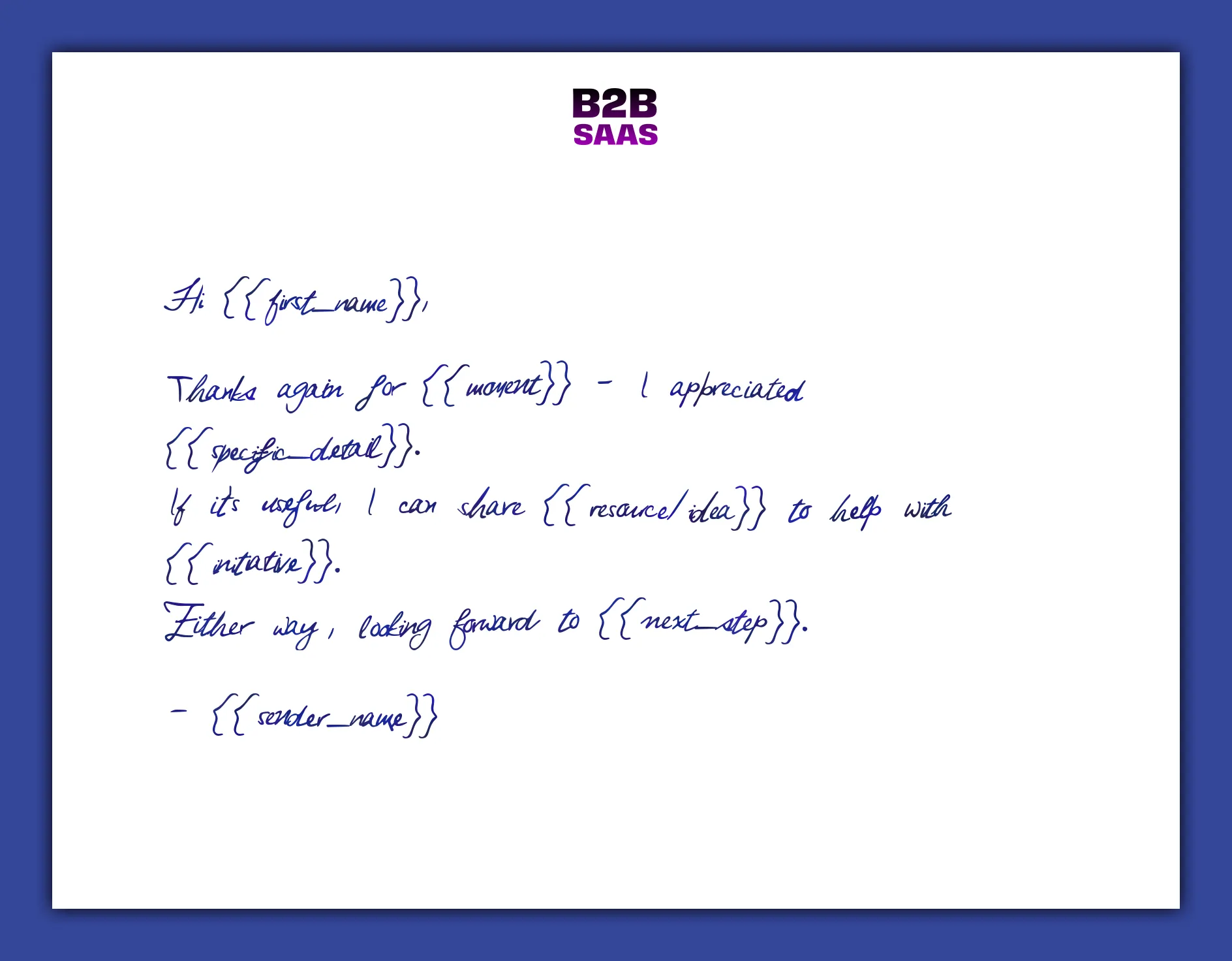
The 4-sentence template
Hi {{first_name}},
Thanks again for {{moment}} — I appreciated {{specific_detail}}. If it’s useful, I can share {{resource/idea}} to help with {{initiative}}. Either way, looking forward to {{next_step}}.
— {{sender_name}}
Business thank you note templates
Use these as starting points. The one thing you should always customize is the specific detail line.
Templates for prospects (sales / growth)
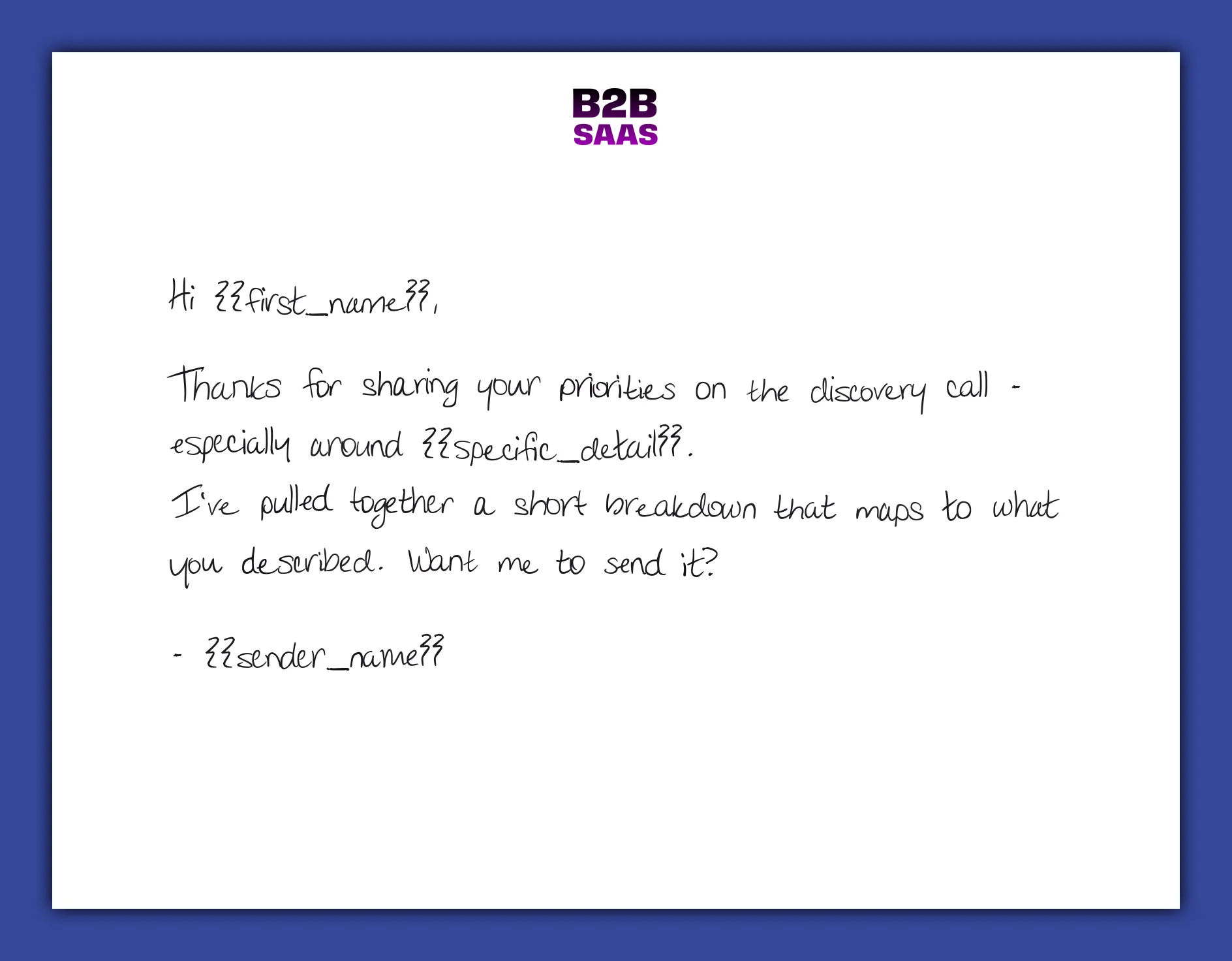
After discovery call
Hi {{first_name}}, Thanks for the time today — your point about {{specific_detail}} was helpful context. If it's useful, I can send a short plan for {{outcome}} based on what's worked for {{peer_group}}. Looking forward to {{next_step}}. — {{sender_name}}
After demo
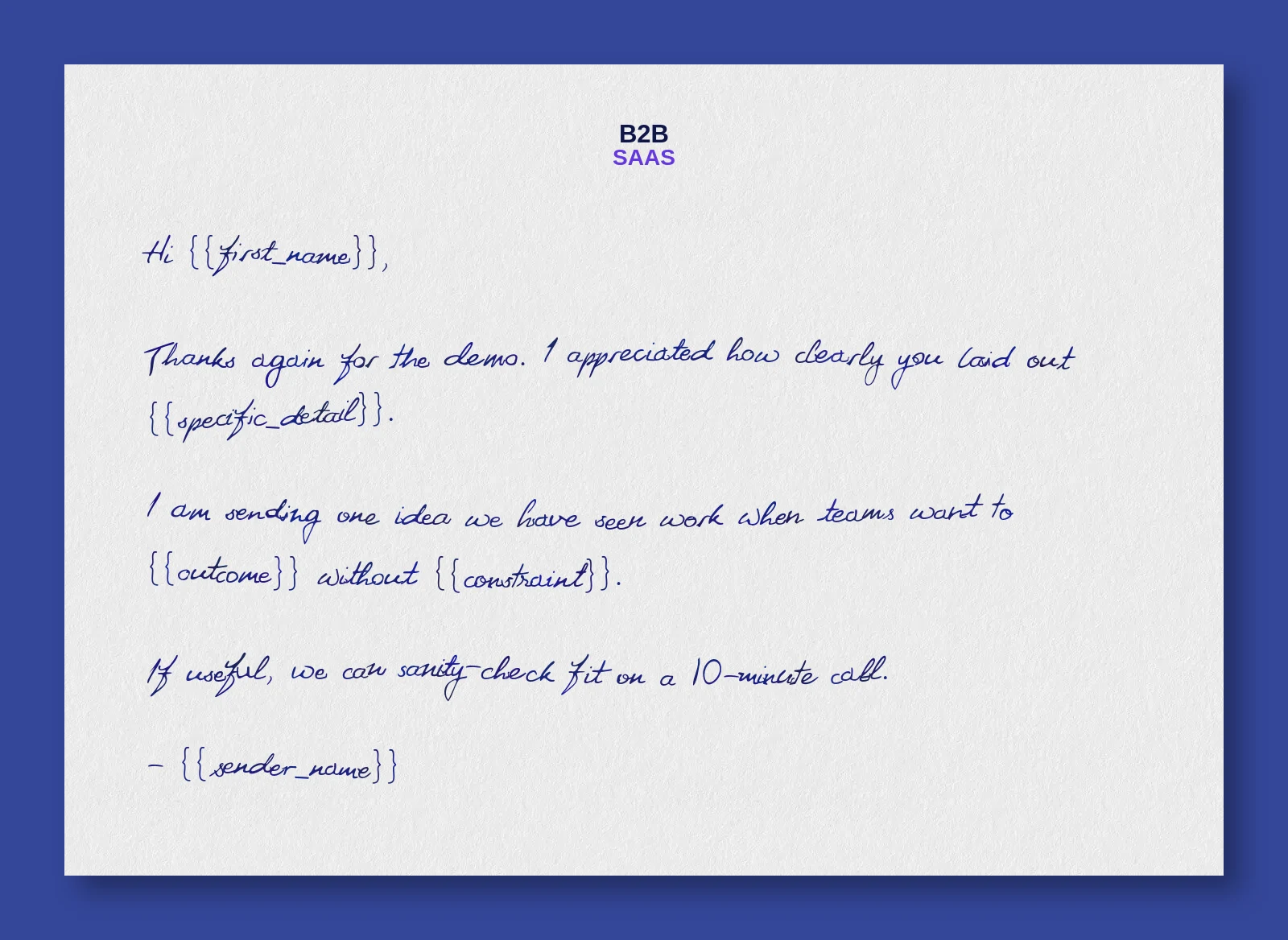
Hi {{first_name}}, Thanks again for the demo — I appreciated how clearly you laid out {{specific_detail}}. I'm sending one idea we've seen work when teams want to {{outcome}} without {{constraint}}. If you want, we can sanity-check fit on a 10-minute call. — {{sender_name}}
After stakeholder meeting (multi-threading)
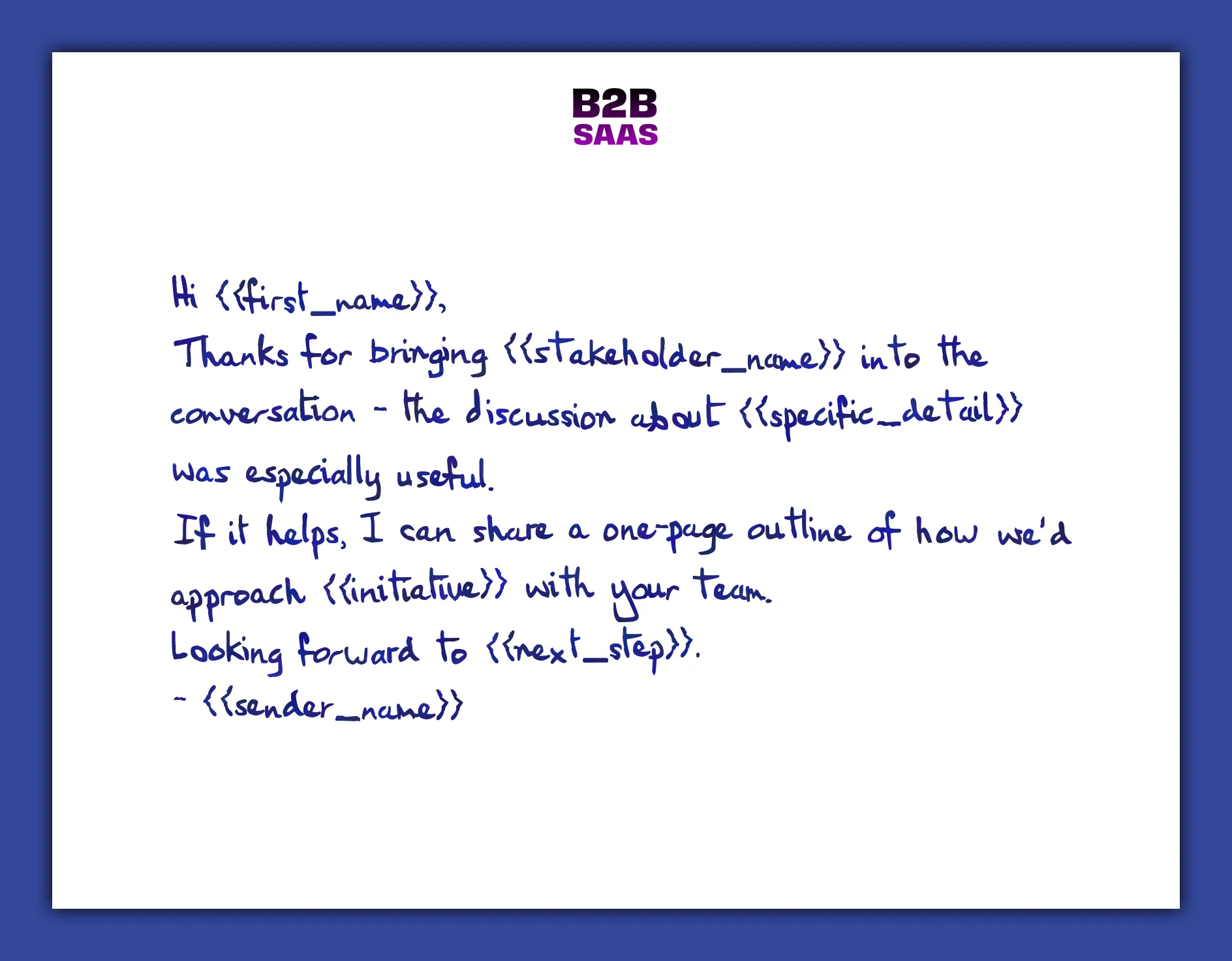
Hi {{first_name}}, Thanks for bringing {{stakeholder_name}} into the conversation — the discussion about {{specific_detail}} was especially useful. If it helps, I can share a one-page outline of how we’d approach {{initiative}} with your team. Looking forward to {{next_step}}. — {{sender_name}}
After “not now” / defer
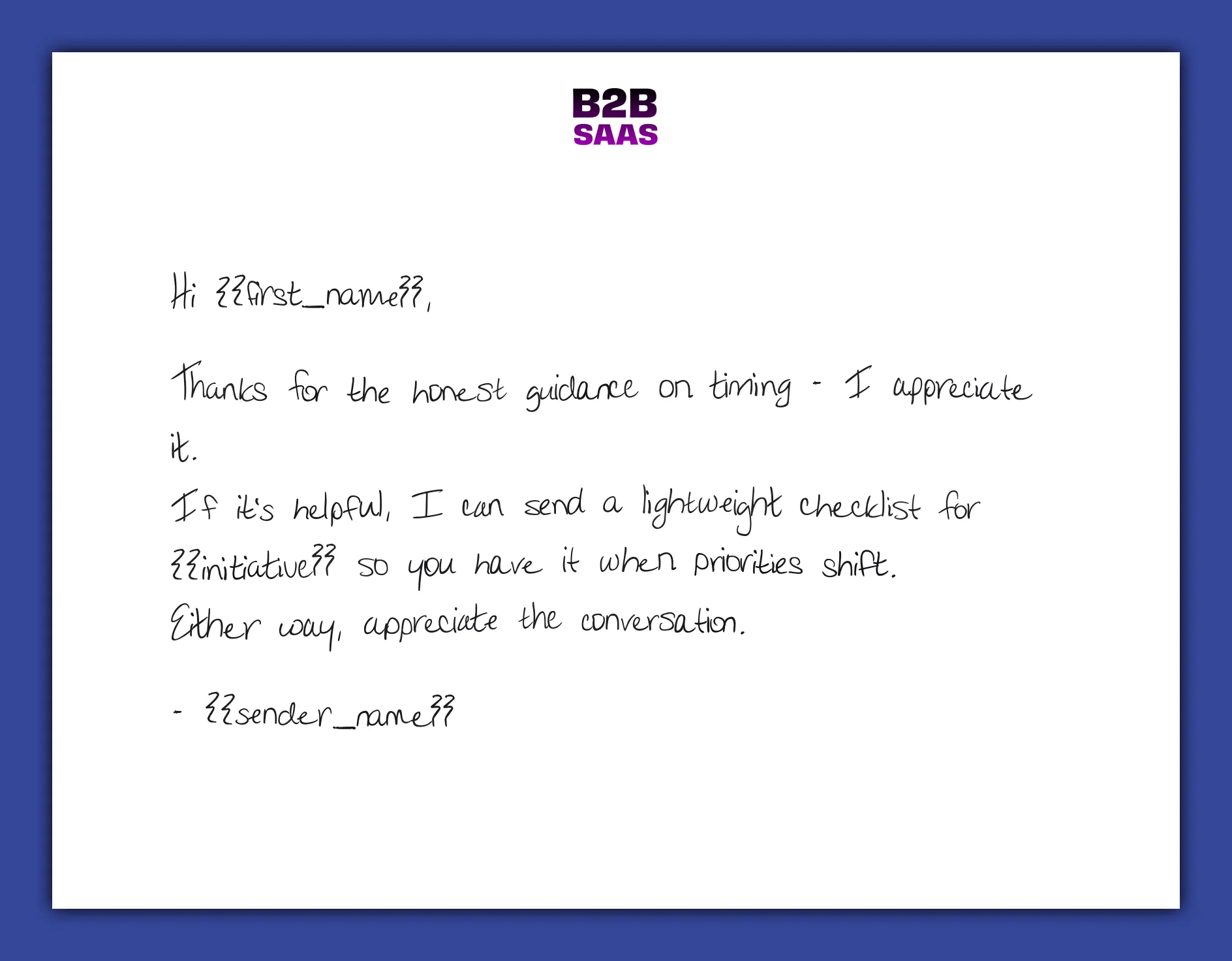
Hi {{first_name}}, Thanks for the honest guidance on timing — I appreciate it. If it’s helpful, I can send a lightweight checklist for {{initiative}} so you have it when priorities shift. Either way, appreciate the conversation. — {{sender_name}}
After an intro (to the person who made it)
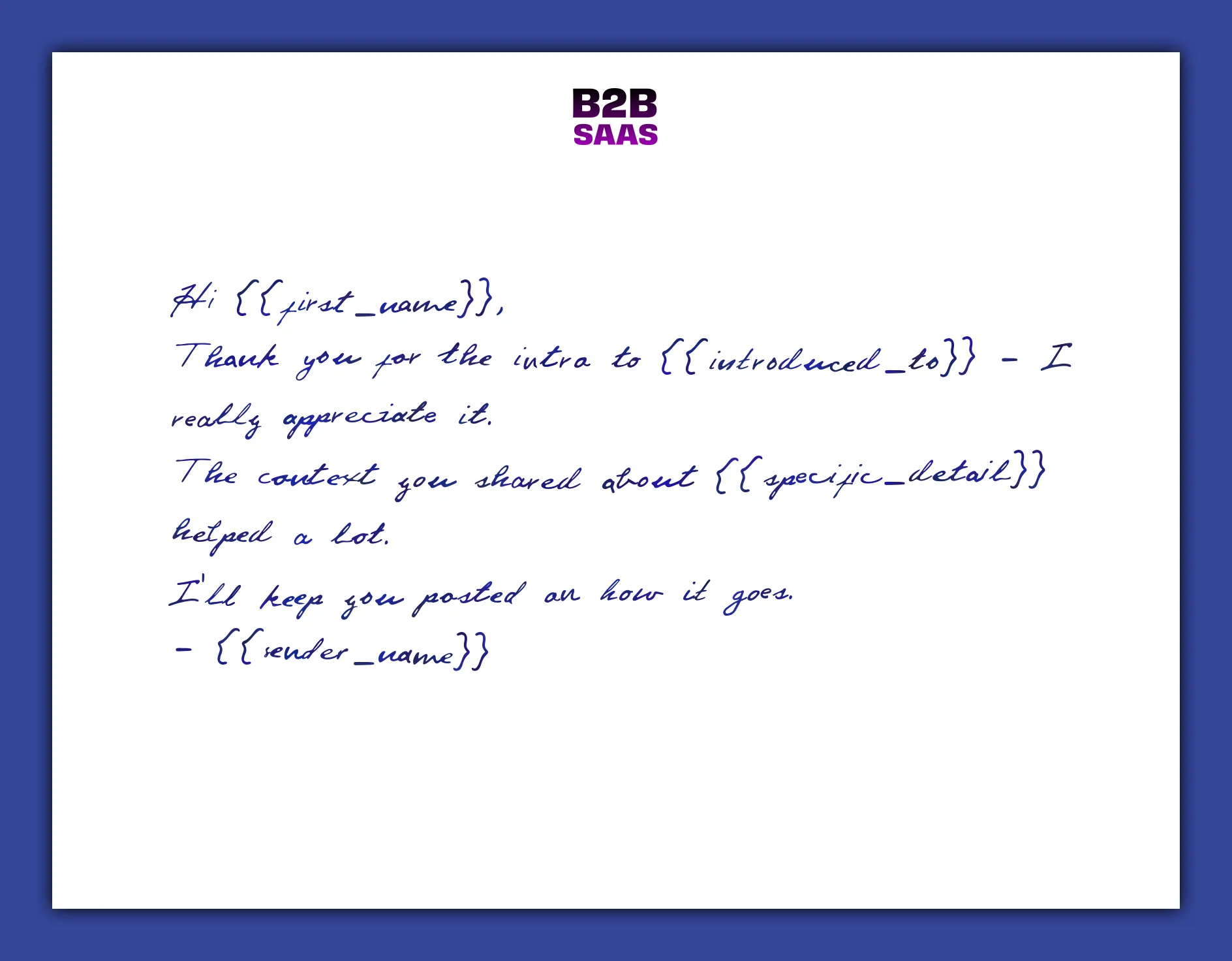
Hi {{first_name}}, Thank you for the intro to {{introduced_to}} — I really appreciate it. The context you shared about {{specific_detail}} helped a lot. I’ll keep you posted on how it goes. — {{sender_name}}
Templates for customers and clients (success / retention / account management)
After onboarding milestone (go-live / first value)
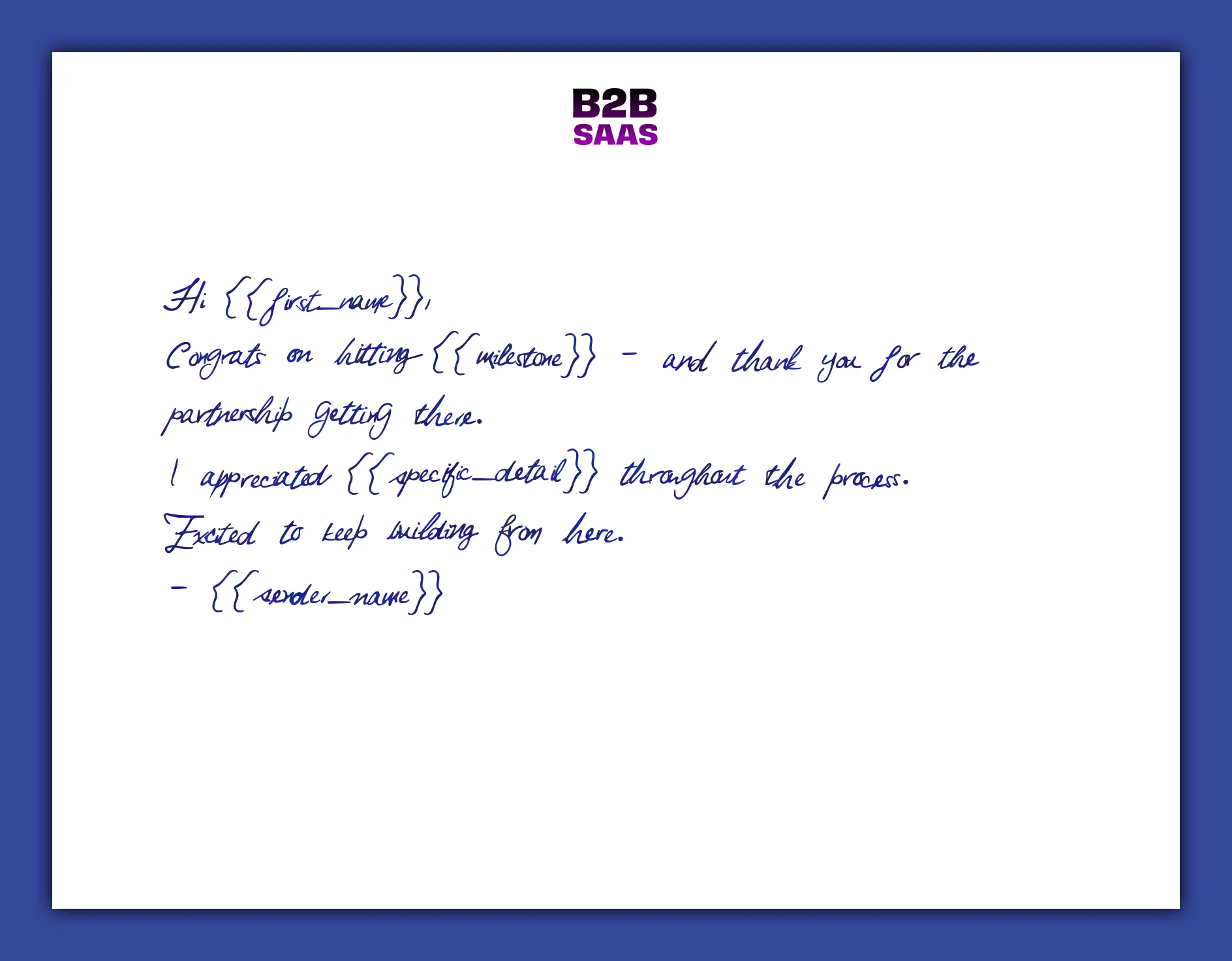
Hi {{first_name}}, Congrats on hitting {{milestone}} — and thank you for the partnership getting there. I appreciated {{specific_detail}} throughout the process. Excited to keep building from here. — {{sender_name}}
After a successful QBR / planning session
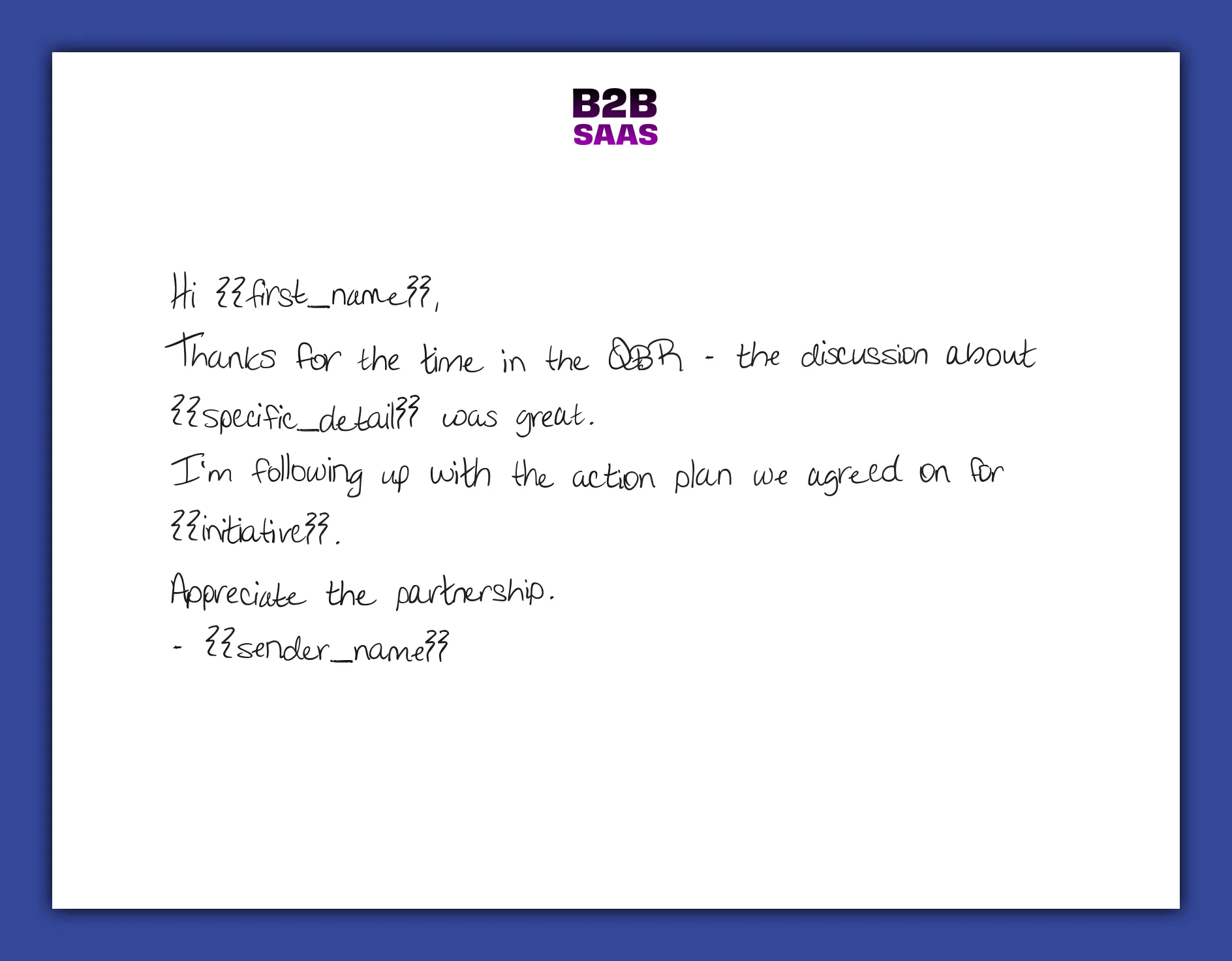
Hi {{first_name}}, Thanks for the time in the QBR — the discussion about {{specific_detail}} was great. I’m following up with the action plan we agreed on for {{initiative}}. Appreciate the partnership. — {{sender_name}}
After renewal
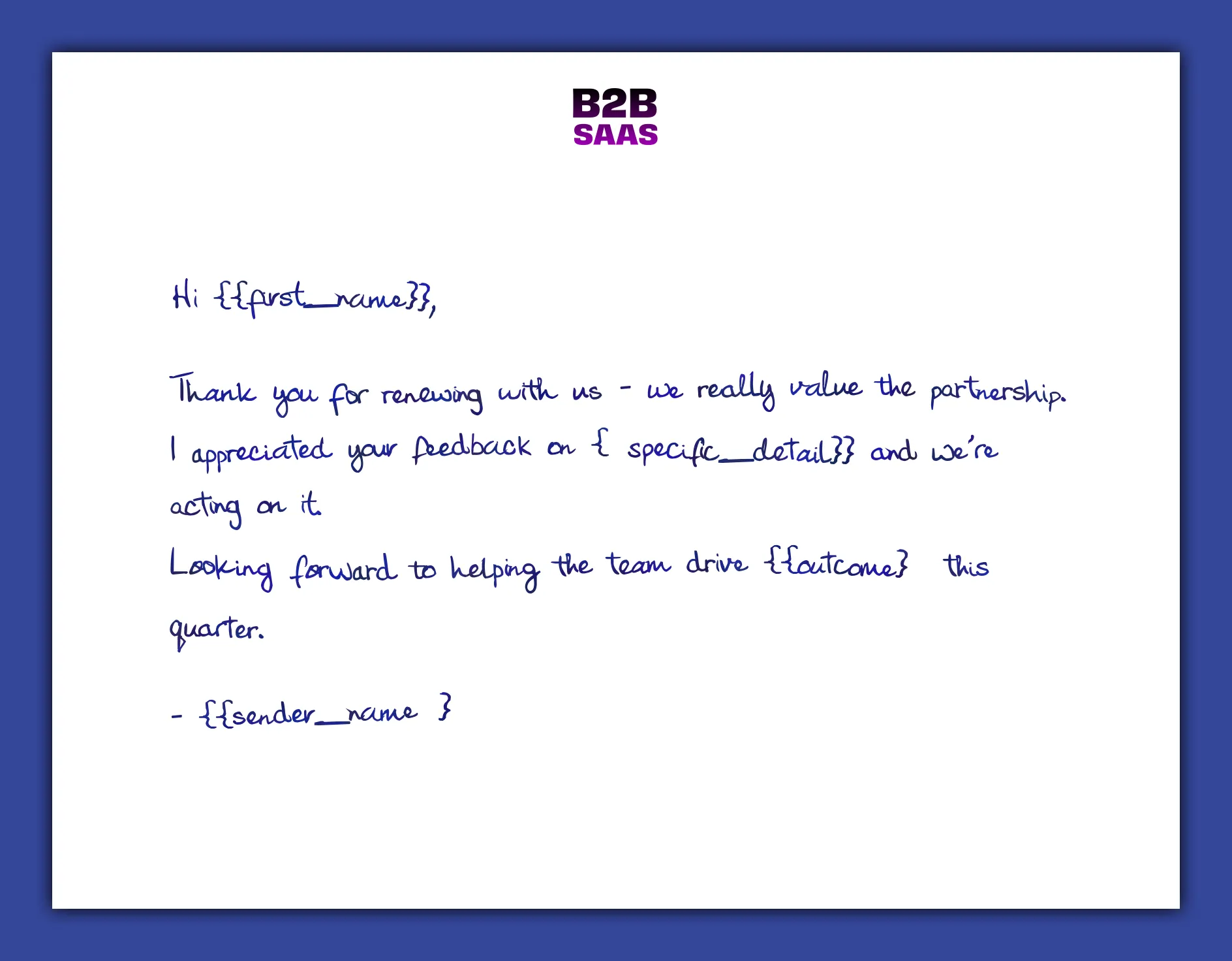
Hi {{first_name}}, Thank you for renewing with us — we really value the partnership. I appreciated your feedback on {{specific_detail}} and we're acting on it. Looking forward to helping the team drive {{outcome}} this quarter. — {{sender_name}}
After expansion
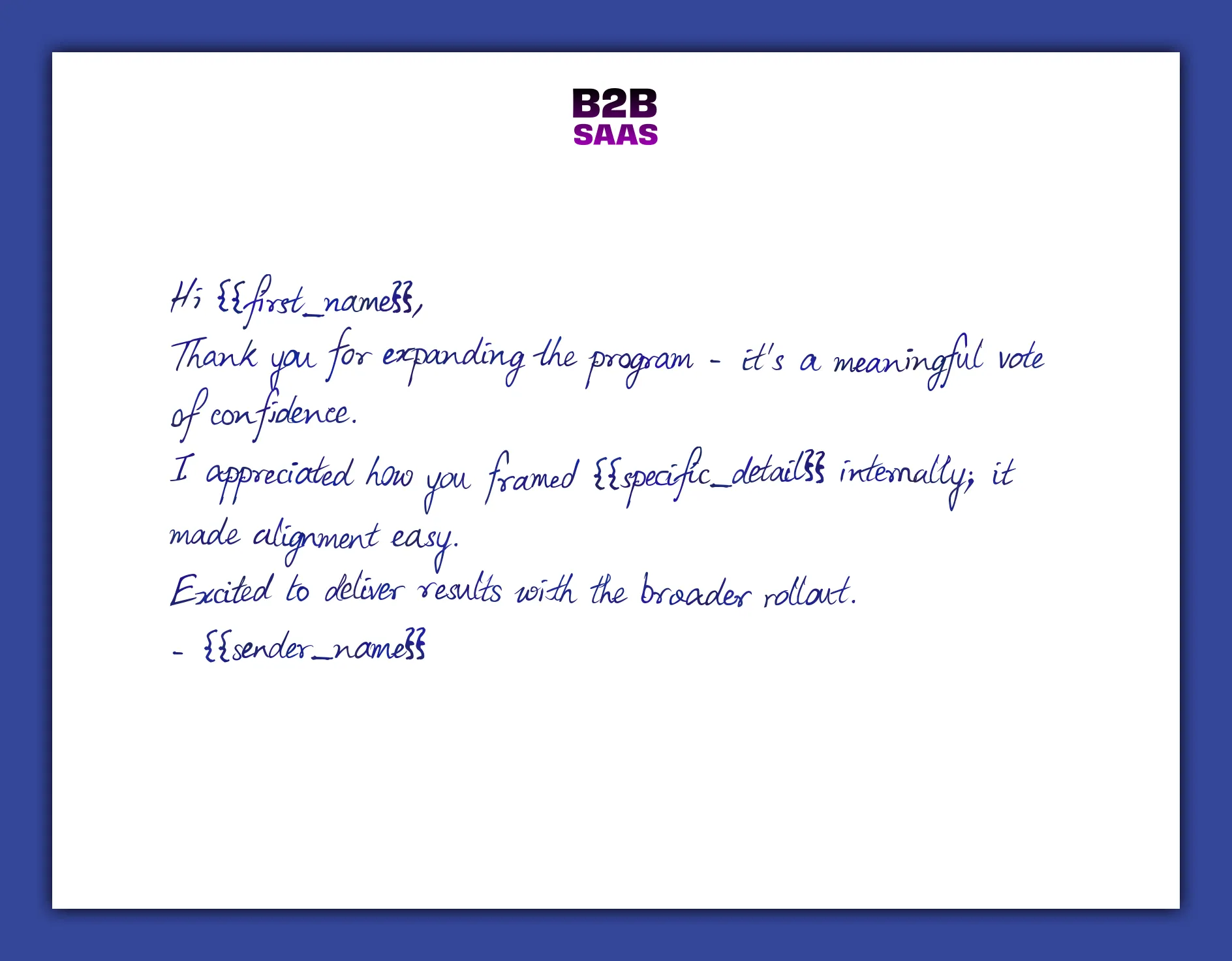
Hi {{first_name}}, Thank you for expanding the program — it’s a meaningful vote of confidence. I appreciated how you framed {{specific_detail}} internally; it made alignment easy. Excited to deliver results with the broader rollout. — {{sender_name}}
After a customer referral
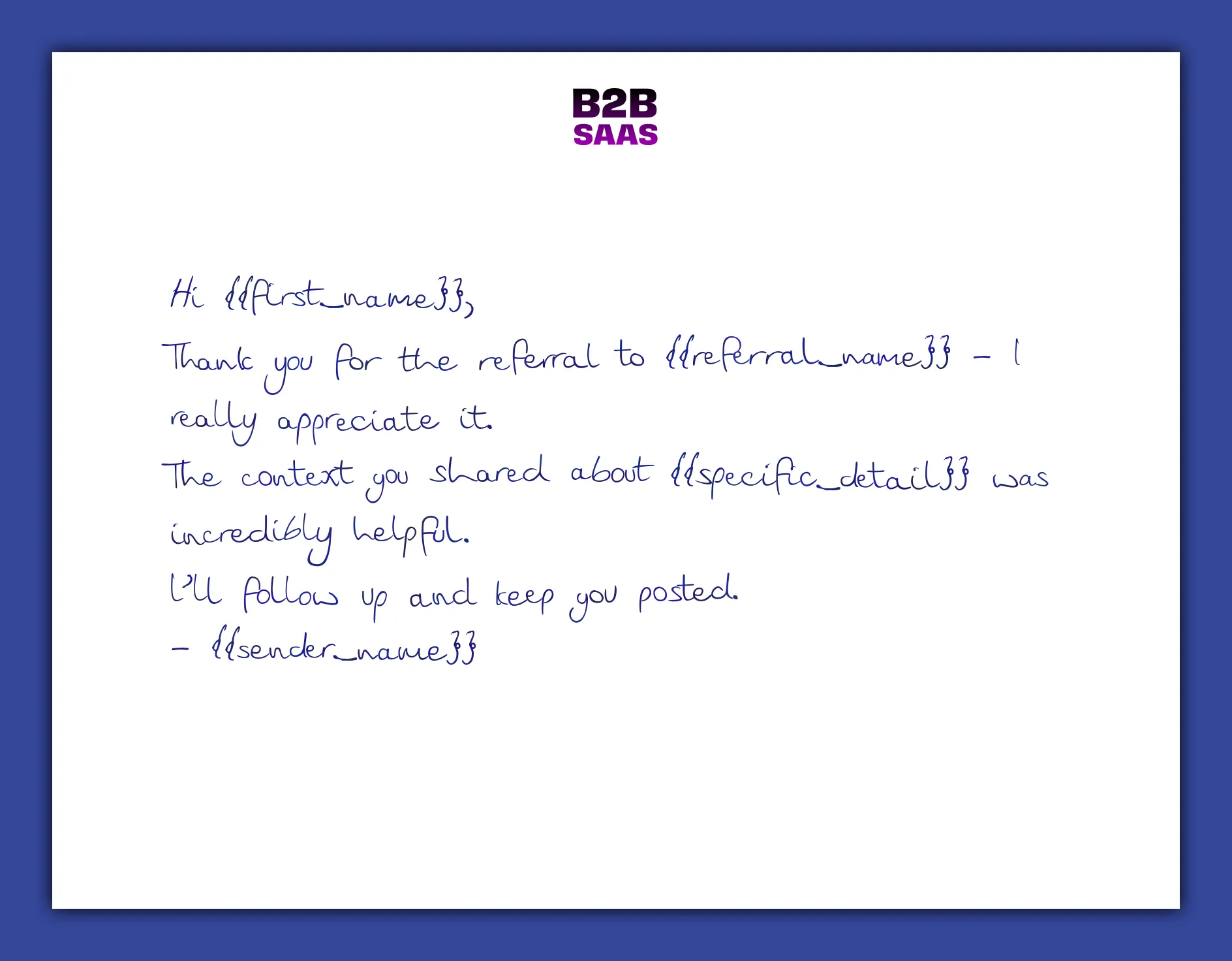
Hi {{first_name}}, Thank you for the referral to {{referral_name}} — I really appreciate it. The context you shared about {{specific_detail}} was incredibly helpful. I’ll follow up and keep you posted. — {{sender_name}}
After a repeat purchase or VIP customer action
Hi {{first_name}}, Thank you for choosing us again — we really appreciate your continued trust. I noticed {{specific_detail}} and wanted to make sure the experience feels as thoughtful as the first one. If there is anything we can make easier next time, I would love to hear it. — {{sender_name}}
After a customer review or testimonial
Hi {{first_name}}, Thank you for sharing your feedback on {{product/service}} — it means a lot to the team. Your point about {{specific_detail}} is exactly the kind of experience we want more customers to have. Appreciate you taking the time. — {{sender_name}}
Templates for partners (alliances / agencies / integrations)
After a co-marketing launch
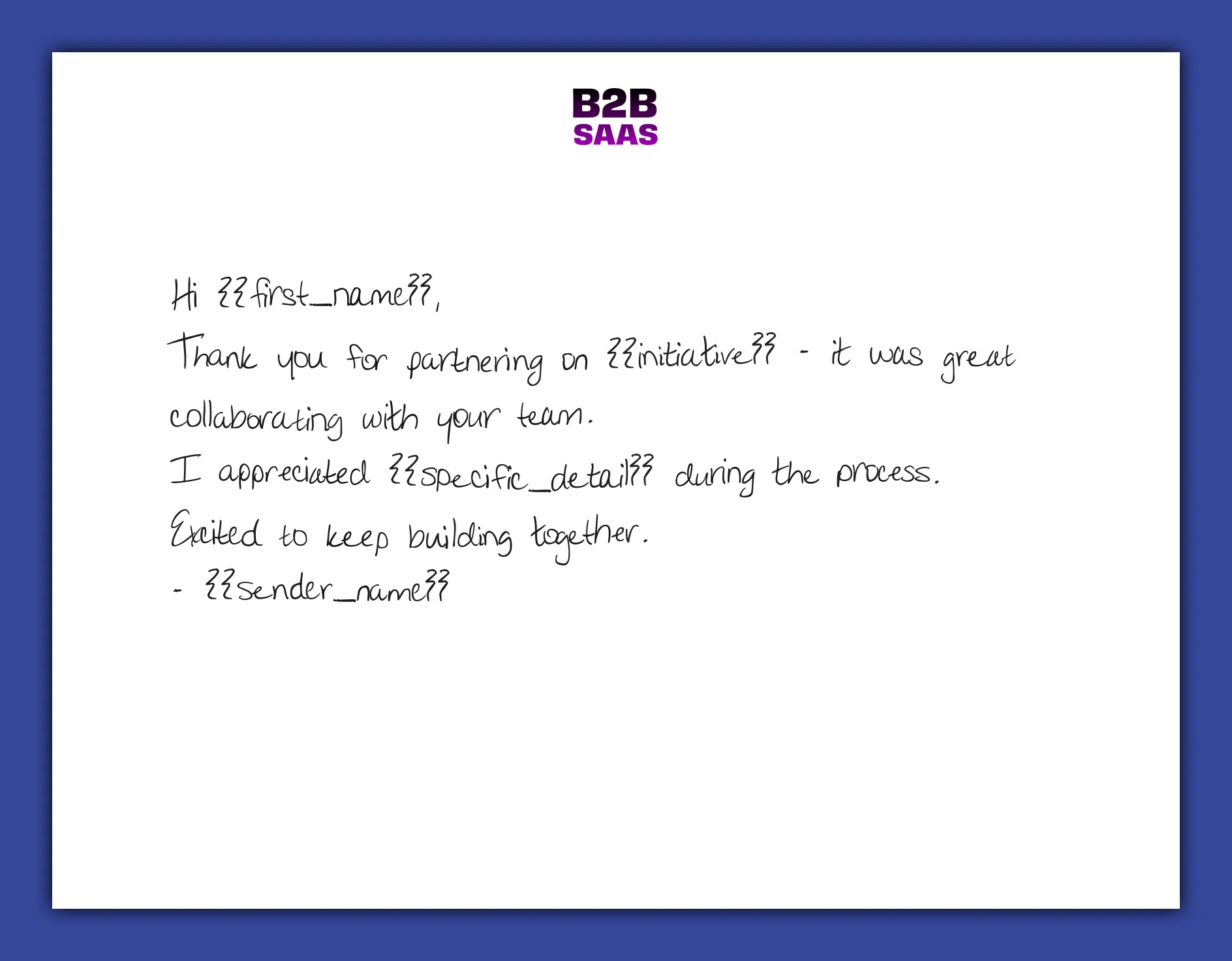
Hi {{first_name}}, Thank you for partnering on {{initiative}} — it was great collaborating with your team. I appreciated {{specific_detail}} during the process. Excited to keep building together. — {{sender_name}}
After a successful deal handoff / joint win
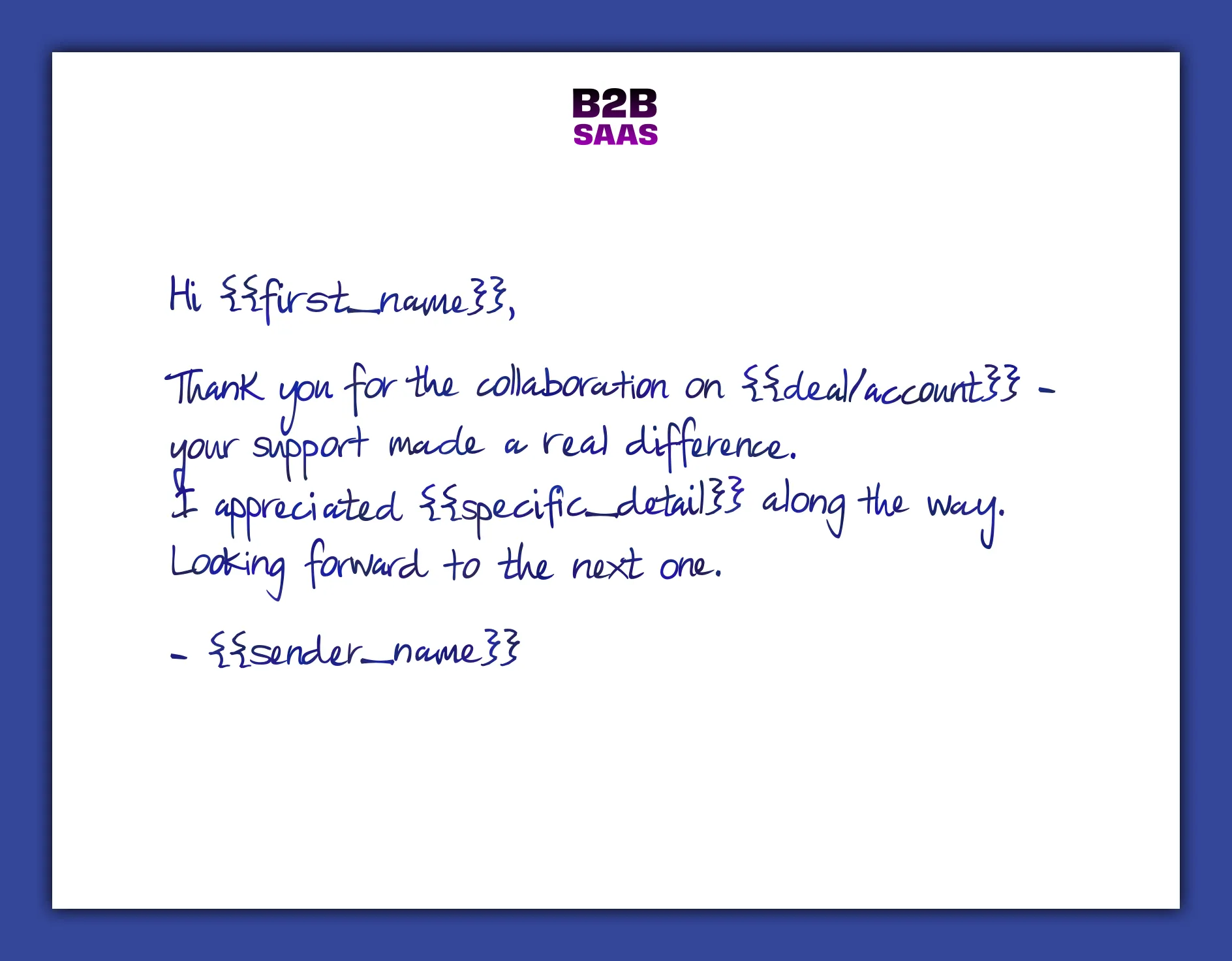
Hi {{first_name}}, Thank you for the collaboration on {{deal/account}} — your support made a real difference. I appreciated {{specific_detail}} along the way. Looking forward to the next one. — {{sender_name}}
How to personalize without spending 30 minutes per note
If your note is going to scale, you need constraints.
Use this “one-line personalization” approach:
- 1 line = proof you listened
- everything else stays consistent
Examples of good “specific detail” lines:
- “Your point about {{priority}} being blocked by {{constraint}} was helpful context.”
- “I appreciated how you framed {{initiative}} for the team.”
- “Your question about {{topic}} was the one we hear from the best-run teams.”
Avoid:
- anything that reveals private tracking (“I saw you visited our site…”)
- anything that feels like surveillance (“noticed you changed titles…” unless it’s a public announcement)
Operationalize it: when to automate thank you notes
Thank you notes become a lever when they’re systematic.
Good automation triggers for business thank you notes:
- meeting completed (demo / discovery)
- opportunity created
- late-stage stall
- onboarding milestone hit
- renewal window opened
- referral submitted
- repeat purchase or VIP segment entered
- review, testimonial, or post-purchase milestone completed
To build a multi-touch motion (mail + email + calls), see: Using Direct Mail with Multi-Touch Campaigns & Optimizing ABM Cadence.
How to measure thank you notes (beyond “we sent them”)
Thank you notes can impact:
- reply rate and meeting show rate
- stage progression speed
- renewal saves and expansion
At minimum, track:
- which segment got a note (and when)
- downstream outcomes in the CRM (meetings booked, opp created, stage moved)
- any direct responses (QR/URL visits, replies referencing the note)
For a practical tracking overview, see: How to track direct mail marketing campaigns.
FAQ
What should a business thank you note say?
A business thank you note should name the specific moment, include one detail that proves the note is personal, and close with a helpful next step only when it fits the relationship.
For the writing framework, see: How to Write a Business Thank You Note.
How long should a business thank you note be?
Most business thank you notes should be four to six sentences. Long notes often feel formal or self-focused, while short notes are easier for customers, clients, prospects, and partners to read.
Should customer, client, and prospect thank you notes be different?
Yes. A customer or client thank you note should reinforce trust, loyalty, outcomes, or retention. A prospect thank you note should acknowledge their time, reflect the business problem discussed, and make the next step easy.
Should I send a thank you note by email or handwritten mail?
Use email when the follow-up is urgent or operational. Use handwritten mail when the relationship moment deserves more attention, such as an executive meeting, referral, renewal, expansion, or important customer milestone.
Can I use these business thank you note examples in automation?
Yes. Use the templates as the fixed message structure, then personalize one line with the meeting detail, account priority, customer milestone, purchase context, or referral. Track sends and outcomes in your CRM or marketing platform so handwritten notes become measurable.
Conclusion
The best business thank you notes are:
- short
- specific
- tied to a real moment
- written like a human (not a campaign)
If you want help setting this up as a repeatable motion (templates, triggers, personalization, tracking), we can help.
Want to send thank you notes at scale without losing the personal touch? Book a campaign consult