

Private School Marketing: How to Increase Enquiries
Private school marketing has to build trust before a family submits an enquiry. This guide shows admissions teams how to combine digital visibility, social proof, events, and personalized direct mail.
Introduction
Private school marketing can be tricky to master. Open houses, feeder-school relationships, and parent referrals still matter, but admissions teams now need a more connected mix of digital and offline touchpoints. Parents compare schools long before they book a tour, and the follow-up experience after each enquiry can influence whether a family keeps moving through the admissions process.
This guide keeps the historically important private school marketing topic intact while focusing on the channels that help admissions and marketing teams build trust: search visibility, open days, social proof, and personalized direct mail.
Why is private school marketing important?
In the past, the name of a famous school was often enough to attract applicants, but things have changed. Competition has increased, and discerning parents want clear evidence that a school offers the right mix of academic outcomes, pastoral support, community, and value for money.
Private schools used to be marketed quite differently than they are today. From a reliance on private school brochures and directory ads, many schools have had to adjust to a more research-led admissions journey. Directory ads can still help prospective families compare academics, extracurriculars, history, and facilities, but they are rarely enough on their own.
Today, private schools still use directory ads as a way to give themselves exposure and get new student applicants or private school tours by prospective parents and students. That being said, there are plenty of newer options and methods in the digital age that are necessary to market your private school effectively. Here are some of our tips to ensure that your private school marketing is covering all the bases and making the best impression on both prospective students and parents.
Build your online presence
Today, having an online presence is a must for private schools. Online private school directory ads and private school websites should both have social media links so parents can be kept up to date with the events in your marketing calendar, and eventually academic calendar once their children have enrolled.
Online reviews where parents can express their views on the private institution, good or bad, are also important. Those few bad ones are important too - no one trusts a school or business with 100% positive feedback! People will suspect reviews are fake, or bad ones are being removed. Transparency is admirable, and the good reviews will stand out more if people are confident they're genuine.
Parents are used to researching major decisions online, so your private school needs a useful website and a clear SEO strategy. Make sure your school's website answers the questions prospective families are searching for, so you are one of the first credible options they see and remember.
Content on a private school website could include:
- An overview of the private institution
- An explanation of the educational philosophy
- Information about the private school campus (including photos)
- Social proof from parents and alumni
- An example timetable
- A calendar of events
Don't forget tradition
It's far easier than in the past for prospective students and their parents to read up on your school without even visiting it, so making sure there is enough online to demonstrate your school's value is super important. But, that doesn't mean that you should neglect the tried and tested channels.
Another important private school marketing tool is the age old method of tours and open days. Many parents still want to see what your school is like before their children get there, and this is where private schools can stand out. Private tours can really sell the school experience to both parents and children, so you should find ways to make them as memorable as possible.
Enjoyable activities, student led tours, alumni and staff presence are all great ways for parents and children to be able to see exactly what your school has to offer, and to hear it from the people who either have experienced the benefits of the school, or are currently there reaping those benefits! Children coming away from an open day should envisage themselves as being comfortable at the school, and parents should be happy to leave their children in your care.
Make sure it's personal
Make sure that, across both your online and offline marketing, you are showing a balance of a good education, but also a wholesome atmosphere. Parents want to see a school that is going to cater to their children's needs as a person, not just as a student. Marketing to parents who are making decisions about their children (and their money!) can naturally be quite emotive, so private school marketing techniques need to be handled with nuance and care.
Sending handwritten notes instead of generic email correspondence is a strong way to show that your school is putting time, effort, and care into each relationship. Parents are looking for trust and reassurance, and handwritten correspondence can help your admissions team show the human side of the school at key moments: after an open day, after a scholarship conversation, after a campus tour, or when a family has gone quiet.
There is also something memorable about receiving physical mail when most follow-up happens by email. If you want a broader framework for using handwritten mail in relationship-led marketing, see our guide to handwritten marketing.
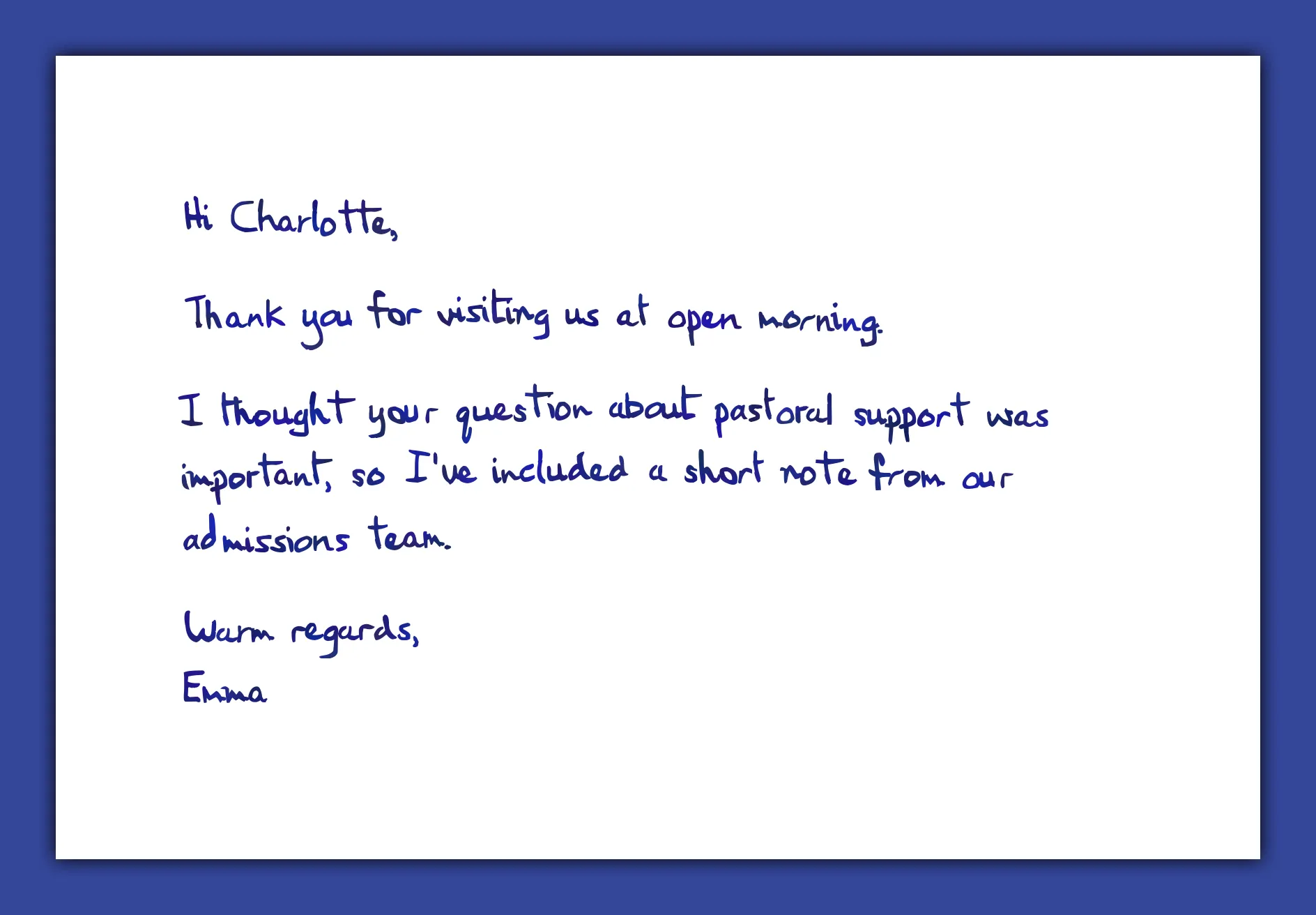
Sending handwritten notes to every parent or prospective applicant manually would take a long time and a lot of resources. With Scribeless, admissions and marketing teams can automate the process while keeping the message personal. If you are already using a CRM for admissions follow-up, the same trigger-based principles in our CRM-triggered direct mail guide can help you plan when notes should send and how to keep the workflow measurable.
Admissions follow-up moments where direct mail can help:
- after an enquiry form submission
- after an open day or school tour
- after a scholarship or bursary conversation
- when a family goes quiet after showing strong interest
- after acceptance, to make the next step feel personal
Stand out from the crowd
Focus on those things which you are confident will set your private school apart from others. Your private school's ethos – what makes it different? What values does it have? It can be difficult to work out exactly what is different about your school's offering, so it may take some time to really nail your USP. Lean into your tradition and history, and hopefully that is a good starting point to identifying why your school's offering is unique - and better than the rest!
There are some arguments that your best marketing tool is the exact group you're trying to impress - the parents! Word of mouth marketing is a channel that's as organic as they come, and considered by many as the single most effective channel. No-one is better placed to know the specific benefits of the school than those who are seeing their children thrive.
Naturally, a private school will want to sing its own praises, but positive words coming from parents whose children are currently enrolled can go a long way. This could form the basis of some social proof on your website, or circulate more organically during open days, alumni networks or general communities. There a ton of benefits of word of mouth marketing - we recommend this blog here to walk you through them all!
Wrapping up
There is no one-size-fits-all strategy for private school marketing. A lot depends on the unique strengths your school can credibly claim. But if you build a connected online and offline approach, respect the role of tradition, and measure what happens after each enquiry, you put your school in a stronger position to increase applications and tours.
If you use direct mail as part of your admissions journey, make it measurable. Unique URLs, QR codes, campaign cohorts, and CRM notes can help you understand which touchpoints support enquiries and visits. For more on that measurement layer, read our guide to direct mail attribution.
Published
08.08.2020
Updated
04.29.2026


