Introduction: the inbox is infinite — the postbox isn’t
If you’re running sales, marketing, customer success, or eCommerce retention in 2026, you’re competing in an environment where messages are cheap.
Your prospects and customers are seeing:
- more cold email than ever
- more “AI-personalized” outreach and lifecycle messaging than ever
- more noise in every digital channel they use
Handwritten notes work for a simple reason: they don’t behave like digital.
They show up in the physical world. They get opened in a different context. They signal effort. And when used at the right moments, they can turn “we’ll see” into “let’s talk,” “thanks for remembering,” or “I’ll buy again.”
This guide is a practical business playbook:
- when handwritten notes beat printed mail (and when they don’t)
- what to write (with templates you can copy)
- how to personalize without being creepy
- how to operationalize notes inside sales, retention, customer success, and eCommerce workflows
- how to measure impact without fooling yourself
If you want background on why direct mail works for sales teams, start here: How direct mail makes an impact for B2B sales.
Who this guide is for
This guide is for business teams that want handwritten notes to do a specific job, not just feel novel. That includes sales teams trying to break through with high-fit prospects, ABM teams targeting strategic accounts, customer success teams supporting onboarding and renewal moments, eCommerce retention teams turning purchases into repeat customers, and founders or operators who want high-value relationship moments to feel more personal.
What we mean by “handwritten notes for business”
This isn’t about personal greetings cards or one-off personal correspondence.
In this guide, “handwritten notes for business” means:
- sales outreach notes to a small, targeted set of prospects
- ABM touchpoints to high-value accounts (tiered by value + intent)
- post-meeting follow-ups that increase reply rates and momentum
- relationship notes to customers, champions, and partners (retention + expansion)
- post-purchase and VIP notes that help eCommerce brands increase repeat purchase, loyalty, and referrals
Handwritten notes are a format — the strategy is still the same:
- relevance beats volume
- timing beats cleverness
- measurement beats vibes
Where handwritten notes fit in a business growth system
Handwritten notes for business work best when they support an existing motion. They should not sit in a separate "direct mail campaign" silo where sales, marketing, eCommerce, and customer success cannot see what was sent.
Use them as a physical touchpoint inside these motions:
| Motion | Best handwritten note role | Example trigger | Primary metric |
|---|---|---|---|
| Outbound sales | Break through with high-fit accounts | Account shows intent, opens multiple emails, or matches Tier 1 ICP | Replies, meetings booked |
| ABM | Create executive attention | Strategic account enters active campaign | Account engagement, pipeline created |
| Opportunity acceleration | Keep momentum after human interaction | Demo completed, workshop held, stakeholder added | Stage progression, next meeting booked |
| Customer success | Reinforce trust at moments that matter | Go-live, first value, renewal window, champion risk | Renewal, expansion, stakeholder engagement |
| eCommerce retention | Make post-purchase moments feel personal | First purchase, VIP threshold, subscription milestone, win-back segment | Repeat purchase, AOV, LTV, reviews |
| Partner marketing | Make relationship-building tangible | Joint launch, referral, partner win | Partner-sourced pipeline, co-marketing activity |
If the primary problem is sales outreach sequencing, read the sales outreach direct mail guide. If the problem is account orchestration, pair this guide with the mailbox-first ABM playbook. If the problem is retention, use the retention direct mail playbook. For eCommerce retention ideas, see How to create a memorable unboxing experience.
The 80/20 rule: use handwritten notes for high-leverage moments
If you try to use handwritten notes like a broadcast channel, you’ll be disappointed (and you’ll overspend).
Handwritten notes are best when:
- your list is small enough to be selective
- your upside per conversion is high enough to justify the cost
- you can tie the note to a real signal (intent, engagement, stage movement)
Think of them as a response layer, not a reach layer:
- Printed mail (reach): broad awareness, low personalization, larger lists
- Handwritten (response): high personalization, smaller lists, high-value moments
- Hybrid: orchestrate both inside a sequence
That distinction matters because handwritten direct mail has different unit economics from printed direct mail. A handwritten note service is usually justified when the expected value of a reply, meeting, renewal save, or executive introduction is high enough to support a more personal touch.
Use this quick format rule:
| Situation | Better format | Why |
|---|---|---|
| Broad awareness list | Printed postcard or letter | Lower cost per touch |
| Tier 1 account with a timely signal | Handwritten note or handwritten letter | More personal, more likely to be noticed |
| Medium-size segment with mixed intent | Hybrid | Printed reach first, automated handwritten notes after engagement or purchase |
| Late-stage deal or renewal risk | Handwritten note | Relationship signal matters more than reach |
For a deeper framework, use the Printed vs Handwritten vs Hybrid Direct Mail format selector.
When to send handwritten notes (business use cases that actually work)
Below are the scenarios where handwritten notes are most likely to be incremental — meaning they create lift you wouldn’t get from email alone.
1) Post-demo (or post-first meeting) — “momentum capture”
Trigger: demo completed, discovery call done, onsite visit, workshop delivered Goal: keep momentum and accelerate the next step Why it works: the buyer already has context; you’re not “cold” anymore
2) Re-engage stalled opportunities — “unstick late stage”
Trigger: opp has stalled for 14–30 days, decision timeline slipping Goal: restart the conversation without being pushy Why it works: it’s a pattern interrupt that doesn’t demand immediate attention like a call
3) Executive-to-executive outreach — “signal seriousness”
Trigger: strategic target account, deal > threshold, mutual connection Goal: show seriousness and open a senior-level thread Why it works: execs are inbox-saturated; mail is different
4) Event follow-up — “make the booth conversation real”
Trigger: met at event, scanned badge, attended dinner/roundtable Goal: convert event context into a real next step Why it works: “great meeting you” email is generic; a note can reference specifics
5) New customer onboarding — “reduce churn risk early”
Trigger: go-live, first value milestone, executive sponsor intro Goal: reinforce “we’re invested” and increase stakeholder buy-in Why it works: onboarding is an emotional period; confidence matters
6) Renewal window — “save and expand”
Trigger: renewal 60/90 days out; champion risk; usage change; NPS/CSAT signal Goal: create goodwill, unblock value conversations, support renewal saves Why it works: retention is won with relationships + value, not reminders
7) Champion moments — “protect your path”
Trigger: champion promotion, job change, internal win attributed to your product Goal: reinforce relationship and keep your internal narrative strong Why it works: champions are leverage; treat them like leverage
8) Professional congratulations — “earn the right to show up”
Trigger: promotion, funding announcement, product launch, award, partner win Goal: start or strengthen a relationship without forcing a pitch Why it works: the note is tied to a real business moment
For more event-specific wording, see these professional congratulations note templates.
9) eCommerce post-purchase — “make the box feel personal”
Trigger: first purchase, high-value order, subscription start, gift purchase Goal: increase repeat purchase, reviews, referrals, and brand recall Why it works: the customer is already emotionally engaged; the note makes the experience feel less automated
10) VIP and win-back moments — “reward attention before it fades”
Trigger: customer reaches VIP threshold, repeats a category purchase, lapses after prior loyalty Goal: strengthen loyalty or bring a valuable customer back Why it works: it gives the customer a human reason to remember the brand beyond the next discount
If you’re looking to build a full sequence that includes mail, this post is a good companion: Using Direct Mail with Multi-Touch Campaigns & Optimizing ABM Cadence.
A simple “send / don’t send” decision framework
Use this to decide whether a handwritten note is worth it.
Send a handwritten note when:
- Account value is high (ACV/LTV supports higher-cost touches)
- Intent is high (engagement, stage movement, real signal)
- List size is small (you can be selective)
- Personalization depth is real (you have a “why you / why now”)
Don’t send (yet) when:
- you can’t articulate the “why now” beyond “checking in”
- you’re sending to a broad list with minimal targeting
- you can’t measure anything beyond “we sent it”
The 4-question scoring model
Before you launch, score each campaign from 0 to 2 on four dimensions:
| Question | 0 points | 1 point | 2 points |
|---|---|---|---|
| Account value | Low value or unclear | Medium value | High ACV/LTV or strategic logo |
| Intent | No recent signal | Light engagement | Strong signal or active opportunity |
| Personalization | Name/company only | Segment-level relevance | Specific "why you / why now" |
| Measurability | No tracking | Campaign-level tracking | CRM touch + downstream outcome tracking |
Send handwritten notes when the score is 6-8. Test carefully at 4-5. Do not send at 0-3 unless the goal is a small brand experiment.
This keeps the team from using handwritten notes as a novelty. The decision becomes operational: is this a high-leverage touch with enough signal, personalization, and measurement to justify the cost?
How to choose a handwritten note service for business
If you are evaluating a handwritten note service or handwritten letter service, do not compare vendors only on handwriting style. For business teams, the harder problem is operational reliability.
Look for five things:
- Personalization controls. You need merge fields, template variants, approval steps, and a way to keep notes specific.
- Automation and integrations. Automated handwritten notes should be triggered from your CRM, marketing automation platform, eCommerce platform, or workflow tool. CSV uploads are fine for one test, but they break down once mail becomes part of sales, retention, and customer workflows.
- Data quality workflows. A good campaign depends on clean names, company fields, postal addresses, country formatting, and suppression rules. Poor list hygiene turns a premium channel into waste. For the list side, use the mailing list hygiene guide.
- Brand and compliance guardrails. Business mail often touches regulated industries, enterprise accounts, VIP customers, or sensitive customer relationships. QA names, titles, claims, offers, sender identity, and do-not-mail preferences.
- Measurement support. At minimum, your handwritten direct mail program should support campaign IDs, template IDs, sent dates, QR or URL tracking, and CRM logging. Without those fields, the channel will be hard to defend when budget review comes around.
The best vendor is the service that helps you send relevant notes on time, with fewer errors, and enough tracking to learn what worked.
For the product workflow behind this, see how Scribeless supports automated handwritten notes for business teams.
What to write: a business handwritten note structure that doesn’t sound like marketing
Most handwritten notes fail for one of two reasons:
- they’re too generic (“just reaching out…”)
- they try too hard (“we’re thrilled to connect…”)
Use this structure instead (keep it short):
- Context (why you’re writing)
- Specificity (proof of relevance)
- Value (one useful idea, insight, or offer)
- Low-friction CTA (one clear next step)
- Human sign-off
The “4 sentence” template
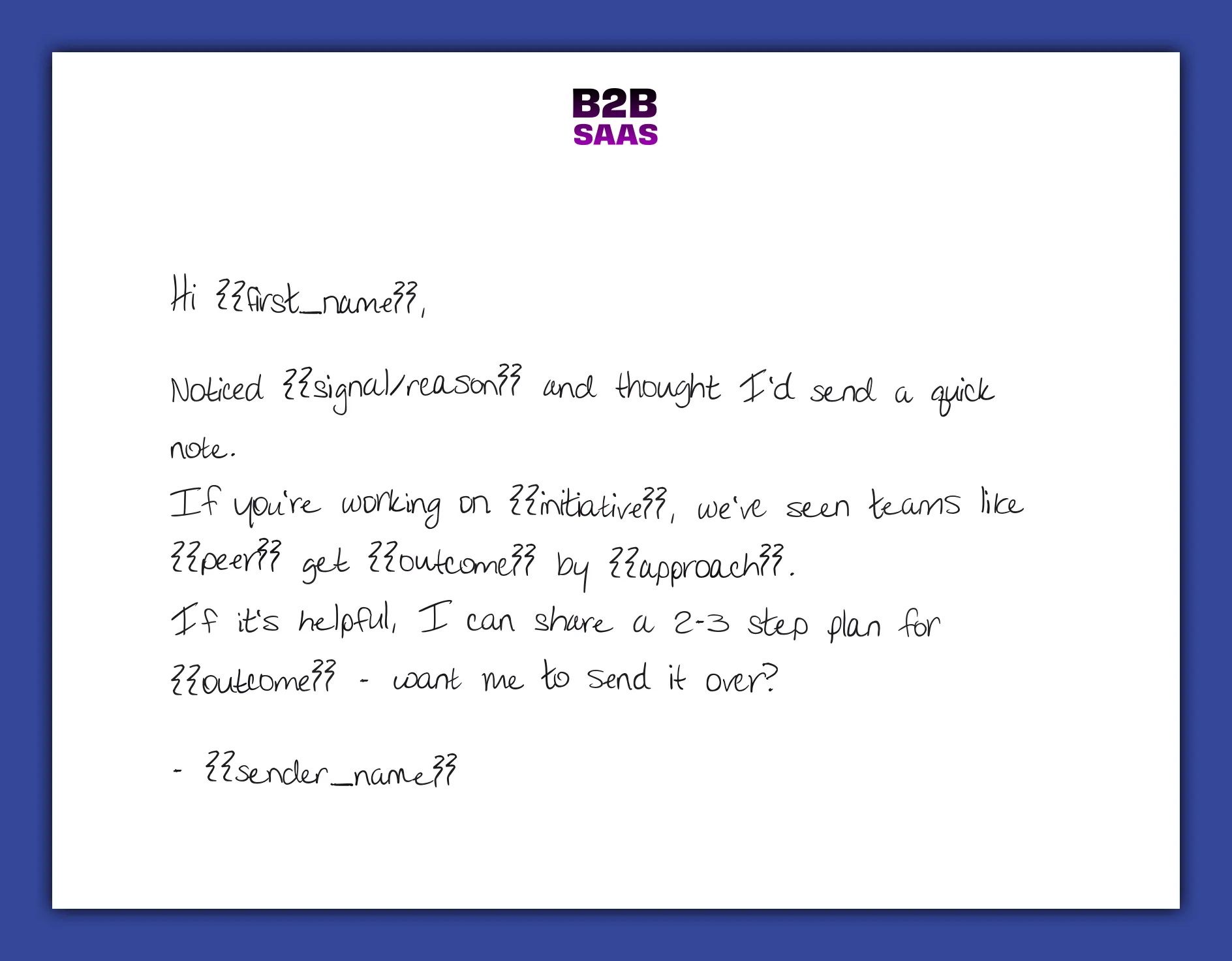
Hi {{first_name}},
Noticed {{signal/reason}} and thought I’d send a quick note. If you’re working on {{initiative}}, we’ve seen teams like {{peer}} get {{outcome}} by {{approach}}. If it’s helpful, I can share a 2–3 step plan for {{outcome}} — want me to send it over?
— {{sender_name}}
Examples
Post-demo follow-up
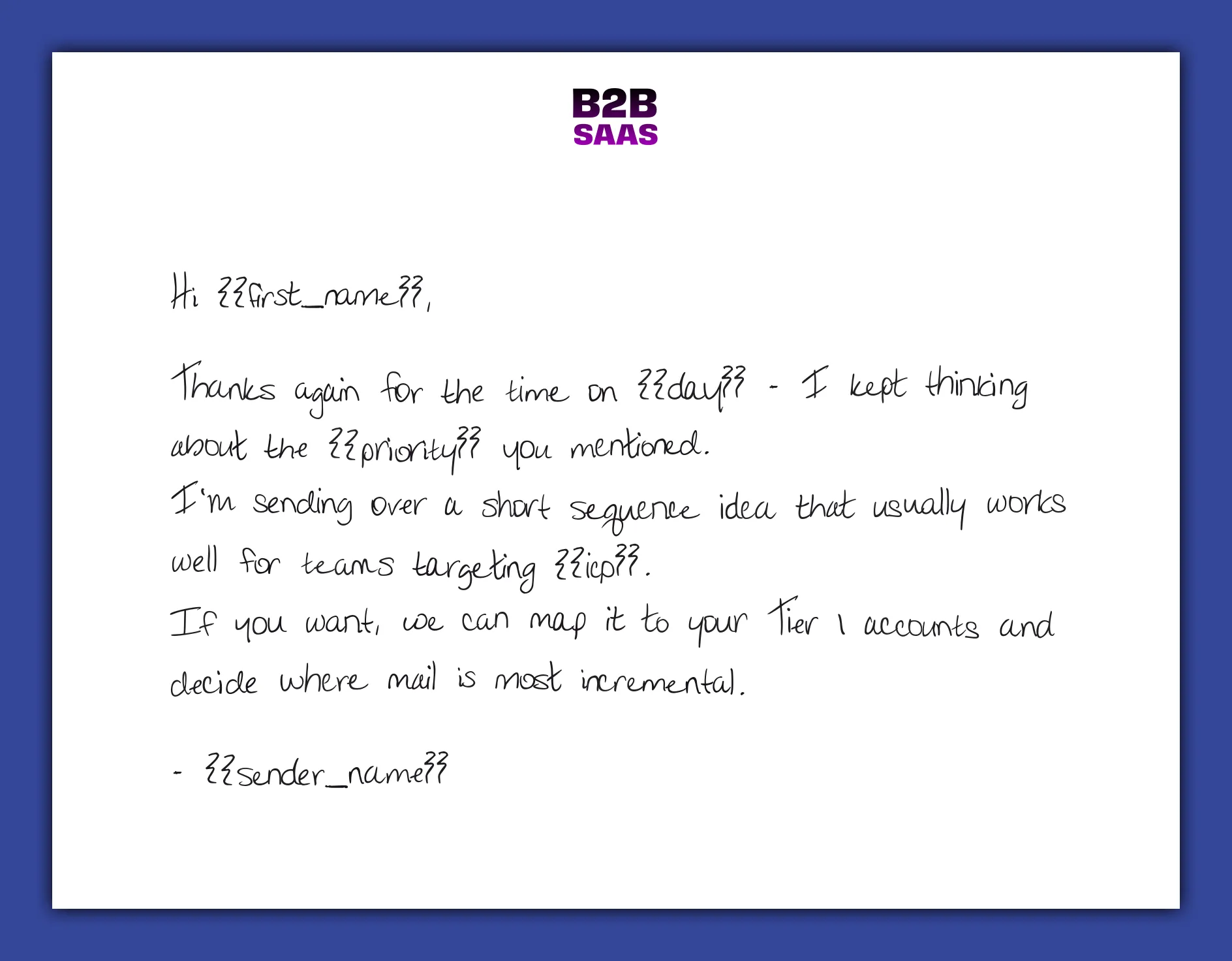
Hi {{first_name}},
Thanks again for the time on {{day}} — I kept thinking about the {{priority}} you mentioned. I'm sending over a short sequence idea that usually works well for teams targeting {{icp}}. If you want, we can map it to your Tier 1 accounts and decide where mail is most incremental.
— {{sender_name}}
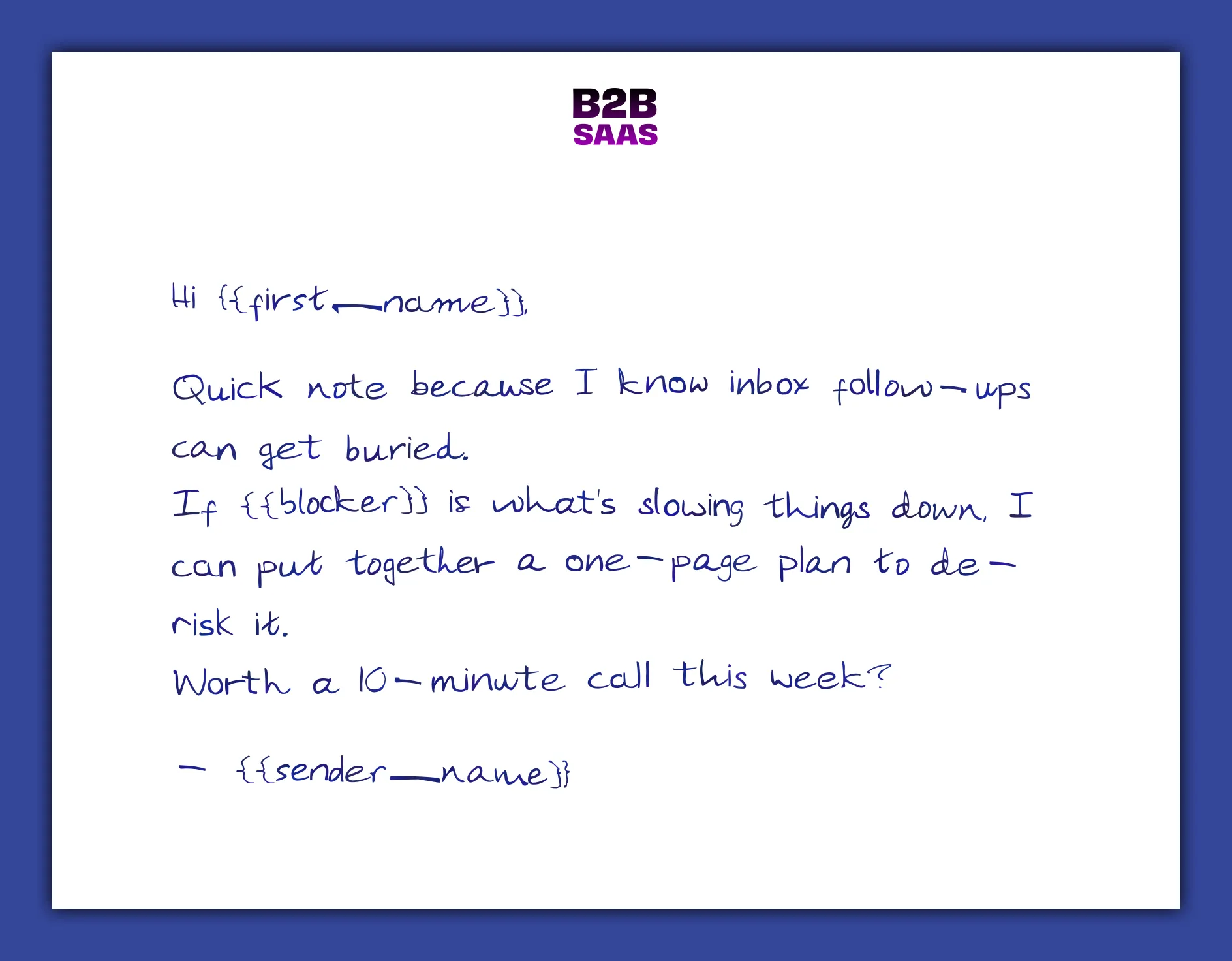
Stalled opp
Hi {{first_name}},
Quick note because I know inbox follow-ups can get buried. If {{blocker}} is what's slowing things down, I can put together a one-page plan to de-risk it. Worth a 10-minute call this week?
— {{sender_name}}
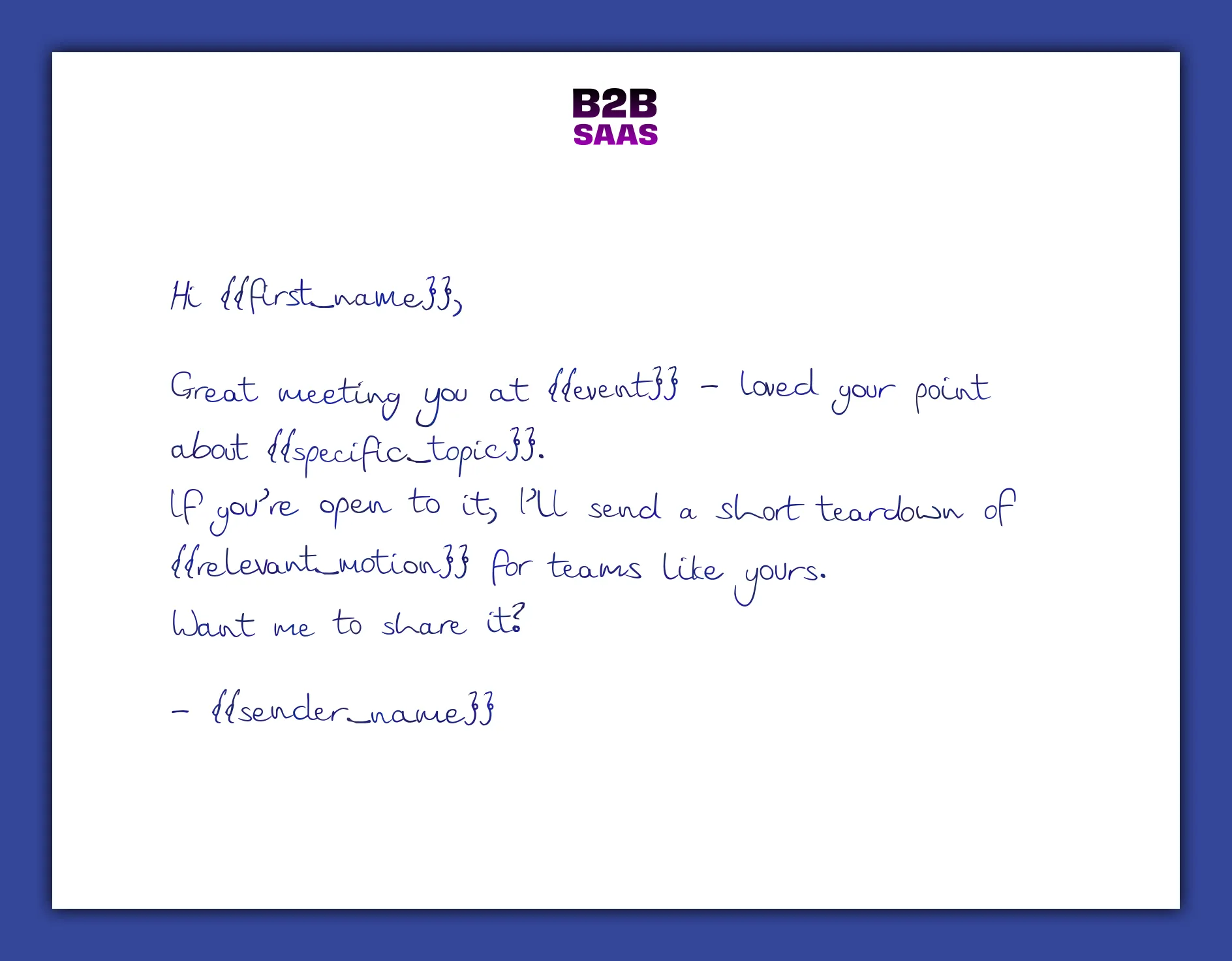
Event follow-up
Hi {{first_name}},
Great meeting you at {{event}} — loved your point about {{specific_topic}}. If you're open to it, I'll send a short teardown of {{relevant_motion}} for teams like yours. Want me to share it?
— {{sender_name}}
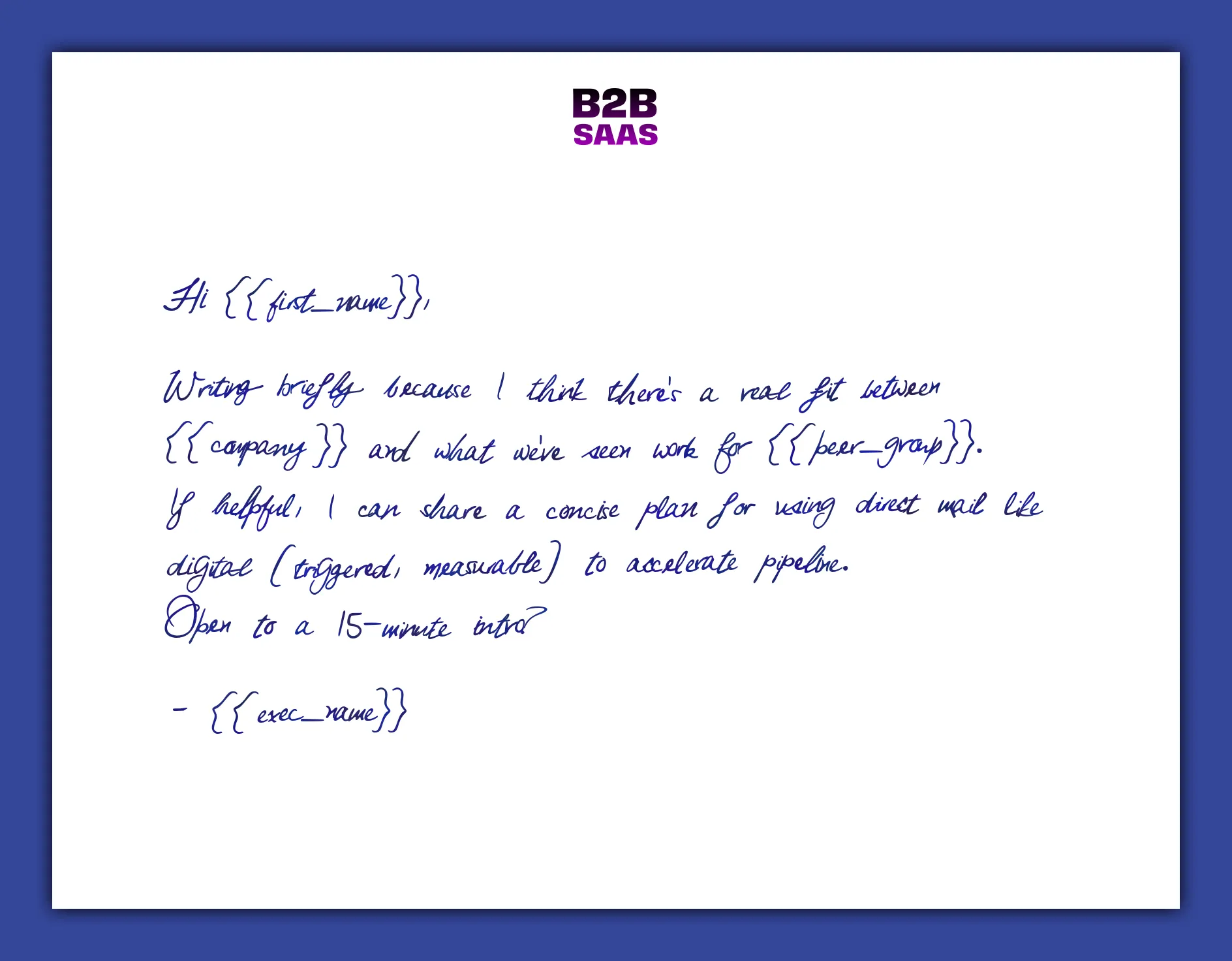
Exec-to-exec
Hi {{first_name}},
Writing briefly because I think there’s a real fit between {{company}} and what we’ve seen work for {{peer_group}}. If helpful, I can share a concise plan for using direct mail like digital (triggered, measurable) to accelerate pipeline. Open to a 15-minute intro?
— {{exec_name}}
New customer onboarding
Hi {{first_name}},
Welcome again to {{company/customer_program}}. I know the first few weeks matter, so I wanted to say personally that we’re focused on helping your team get to {{first_value_milestone}} quickly. If anything feels unclear, send me a note and I’ll make sure the right person helps.
— {{sender_name}}
Renewal or champion risk
Hi {{first_name}},
I wanted to say thanks for the partnership this year, especially around {{specific_project_or_win}}. As you plan the next phase, I’d be happy to help summarize the value delivered so your stakeholders have a clear view before renewal discussions. Want me to put that together?
— {{sender_name}}
Congratulations note
Hi {{first_name}},
Congratulations on {{milestone}}. It’s a meaningful signal of the work your team has been doing around {{business_area}}. Wishing you a strong next chapter, and happy to share anything useful as priorities evolve.
— {{sender_name}}
eCommerce first purchase
Hi {{first_name}},
Thanks for your first order from {{brand}}. I hope {{product_or_category}} is exactly what you were looking for. If you have any questions once it arrives, just reply to the team and we’ll help.
— {{sender_name}}
eCommerce VIP customer
Hi {{first_name}},
I noticed you’ve been with {{brand}} for {{customer_milestone}}, and I wanted to say thank you properly. Customers like you shape what we build, stock, and improve next. We appreciate you.
— {{sender_name}}
For more thank-you phrasing and scenarios, use these business thank-you note templates.
Personalization without creepiness: the “receipt test”
If your note feels like surveillance, it backfires.
Use the receipt test:
- could the person reasonably understand how you know this?
- would it still feel normal if you said it out loud in a room?
Good personalization sources:
- what they shared on a call
- a public role change or announcement
- a public case study, job post, or product page
- a clear firmographic fit (industry, size, motion)
- customer behavior they would expect you to know, such as first purchase, VIP status, subscription milestone, or product category
Be careful with personalization that sounds like surveillance:
| Safer | Riskier |
|---|---|
| "Saw your team announced a new partner program." | "I noticed you viewed our pricing page three times." |
| "You mentioned pipeline quality on our call." | "Your SDR opened my last email at 9:14." |
| "Your hiring page suggests expansion in EMEA." | "Your team has been researching vendors like us." |
| "Thanks for your first order from our skincare range." | "I saw you abandoned cart twice last week." |
Personalization checklist (keep it simple):
- 1 “why you” line (specific, grounded)
- 1 “why now” line (timely signal)
- 1 value line (idea, resource, offer)
- 1 next step (low friction)
AI can help generate first drafts of personalization, but it should not be trusted as the final authority. Use AI for summarizing account context, proposing a "why now" line, or adapting a template by industry. Keep a human QA step for Tier 1 accounts, regulated industries, and any note that references a person’s career, company performance, or customer relationship.
If you want a workflow for scaled personalization, read Clay + Scribeless for ABM personalization. For a broader approach, see Leveraging Technology: Personalization & Data Driven Campaigns.
Operationalizing handwritten notes (so it’s not a one-off stunt)
If you want handwritten notes to drive pipeline consistently, you need a system.
Step 1: tier your accounts
Example:
- Tier 1: strategic accounts, top customers, VIPs → handwritten notes + letters
- Tier 2: engaged accounts or repeat customers → hybrid (postcards + selective handwritten)
- Tier 3: broad prospects or one-time buyers → printed reach mail only (or none)
Step 2: choose triggers (not calendars)
Good triggers:
- stage change (demo booked, opp created, late stage)
- engagement threshold (multiple site visits, webinar attended, reply)
- time-based risk (opp stalled, renewal window)
- customer milestone (first order, third order, subscription start, VIP threshold, lapsed high-value customer)
Step 3: build a reusable template with variables
Keep 70–80% standard and 20–30% variable:
- {{first_name}}, {{company}}
- {{signal}}
- {{initiative}}
- {{peer_company}} or {{industry}}
Minimum data model:
| Field | Why it matters |
|---|---|
| contact_name | Prevents awkward or incorrect salutations |
| company_name or customer_segment | Makes the note relevant to the recipient |
| postal_address | Required for delivery and dedupe |
| account_tier or customer_tier | Controls who qualifies for handwritten mail |
| trigger_reason | Explains "why now" |
| personalization_line | Keeps relevance concise |
| campaign_id | Connects the send to reporting |
| last_sent_date | Enables frequency caps |
| suppression_status | Prevents sends to excluded contacts |
Step 4: add QA guardrails
Minimum QA:
- no missing variables
- no incorrect pronouns/titles
- no “obviously AI” tone
- no personalization that fails the receipt test
Step 5: instrument measurement before scaling
At minimum:
- a unique QR or URL per campaign
- UTMs or tracking parameters
- CRM fields to capture “mailed” touchpoint date
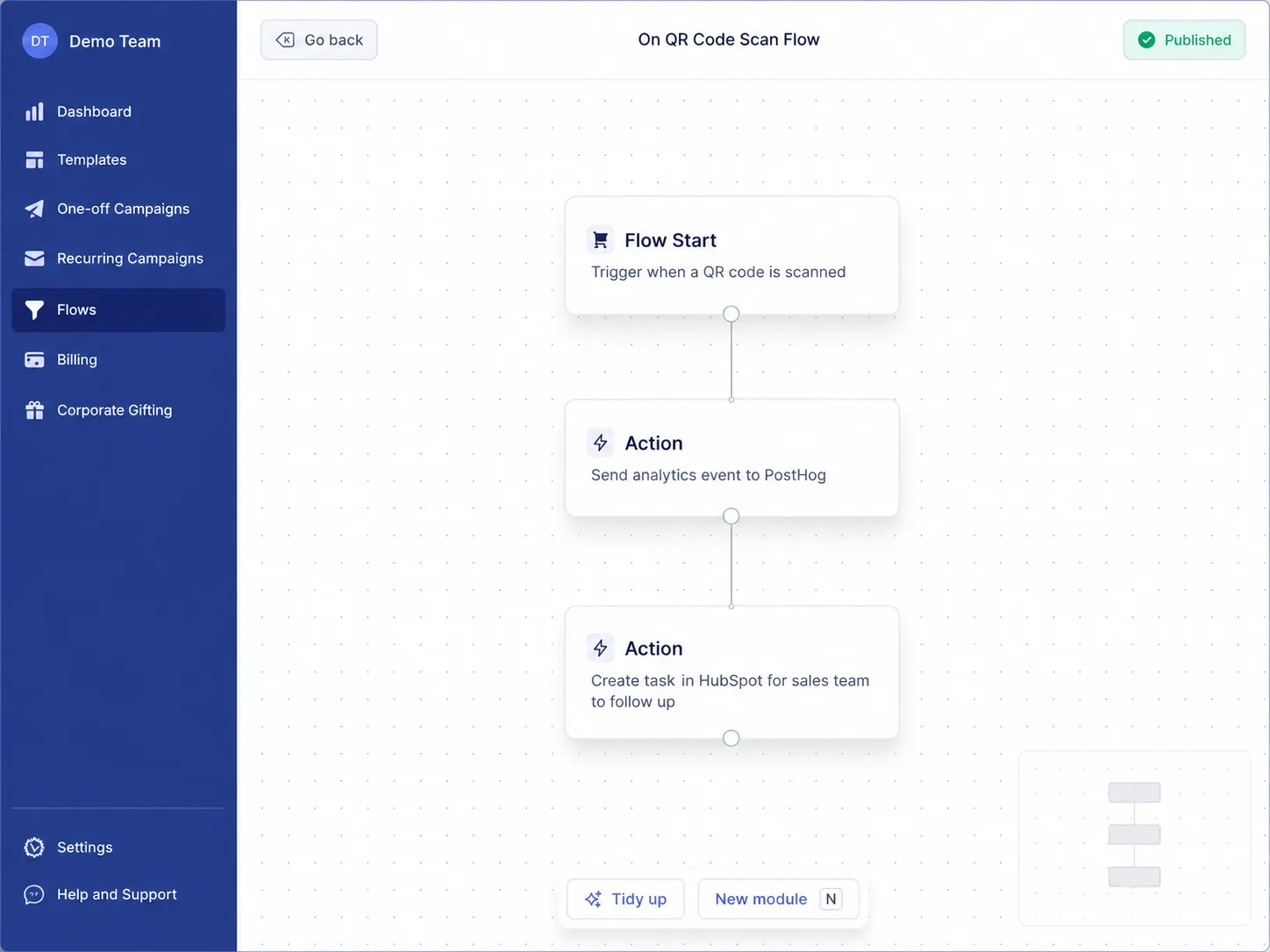
For CRM implementation, see these CRM-triggered direct mail workflows. For a deeper tracking overview, see How to track direct mail marketing campaigns.
How to measure impact (without lying to yourself)
Handwritten notes influence outcomes that don’t always show up as last-click conversions.
Aim to measure at three levels:
1) Direct response
- QR scans / landing page visits
- form fills
- replies that reference the note
2) Funnel movement
- reply rate lift for accounts who received notes
- meetings booked
- opportunity creation rate (for outbound)
- stage progression velocity
- repeat purchase rate or win-back rate (for eCommerce)
- review, referral, or loyalty-program participation
3) Incremental lift (gold standard)
If you can, use a holdout group:
- send to a randomized subset of a segment
- compare downstream outcomes vs the holdout
What to avoid
Avoid claiming success because one recipient scanned a QR code, one customer reordered, or one deal closed after a note was sent. Those are useful signals, not proof by themselves. The stronger question is: did the mailed cohort perform better than a comparable unmailed cohort?
For a practical attribution model, use the direct mail attribution guide. It covers QR codes, PURLs, CRM matchbacks, and holdouts in more depth.
Common mistakes (and what to do instead)
Mistake 1: mailing everyone
Do instead: tier accounts and reserve handwritten for high-leverage moments.
Mistake 2: generic “checking in” notes
Do instead: tie every note to a real signal and a specific next step.
Mistake 3: turning the note into a brochure
Do instead: 4–6 sentences, one clear CTA.
Mistake 4: no measurement plan
Do instead: decide upfront what success looks like and how you’ll track it.
Mistake 5: creepy personalization
Do instead: reference public, volunteered, or business-relevant context only.
Mistake 6: automating before the workflow is proven
Do instead: test the trigger, copy, audience, and QA process manually before turning on always-on automation.
FAQs about handwritten notes for business
Are handwritten notes still effective for business?
Yes, when they are selective, relevant, and tied to a real business moment. They are less effective when used as generic promotional mail. The strategy still depends on targeting, timing, copy, and measurement.
What is the difference between handwritten notes and handwritten direct mail?
Handwritten notes are short, personal messages sent to prospects, customers, partners, or stakeholders. Handwritten direct mail is the broader campaign category: notes, letters, envelopes, inserts, and automated workflows used in sales, ABM, customer success, eCommerce, or retention.
When should sales and marketing teams send handwritten notes?
Sales and marketing teams should send them after high-intent moments: a completed demo, an event conversation, a stalled opportunity, an executive intro, a first purchase, a VIP milestone, or a strategic account signal. They should not send them to every cold lead or every one-time buyer.
Can handwritten notes be automated without feeling fake?
Yes, if automation handles the workflow and humans still control the relevance. The safest model is a structured template with one or two thoughtful variables, frequency caps, QA, and CRM-triggered rules. Automation should remove operational drag, not remove judgment.
How long should a business handwritten note be?
Most business notes should be 4-6 sentences. Long notes become sales letters. The goal is to create attention, show relevance, and prompt one next step.
What should a handwritten note include?
Include a specific context line, one relevant observation, one value line, and one low-friction next step. Avoid feature lists, heavy claims, and generic "checking in" language.
How do you measure handwritten note campaigns?
Measure direct response, CRM outcomes, and incremental lift. Use campaign IDs, QR or trackable URLs, sent dates, matchbacks, and holdouts where possible. Do not rely only on last-click attribution.
Conclusion: use handwritten notes like a system, not a gimmick
Handwritten notes are not a magic trick. They’re a high-leverage format.
Used well, they:
- create a pattern interrupt in a noisy market
- strengthen relationships at critical moments
- and make your other channels (email, calls, events) work harder
If you want help designing a mailbox-first program (tiering, templates, triggers, and measurement), we can help.
Ready to add handwritten mail to your sales, retention, or eCommerce motion? Book a campaign consult