Introduction: the note only works if it sounds specific
A business thank you note is easy to write badly.
Most teams default to:
- "Thanks for your time."
- "We appreciate your partnership."
- "Looking forward to staying in touch."
Those lines are polite, but they are also forgettable. In business, the thank you note has a job: make a customer, client, prospect, partner, or champion feel that the relationship is seen and worth continuing.
This guide focuses on how to write the note: structure, tone, timing, personalization, and mistakes to avoid. If you mainly need copy-and-paste examples, use the companion template hub: Business Thank You Note Templates and Examples.
Use this guide if you need the process, not just templates
This page is the how-to companion to the template library.
- Use this guide to decide what to say, how long the note should be, what tone to use, and how to avoid generic or awkward wording.
- Use the template hub when you want copy-ready examples for prospects, customers, clients, referrals, renewals, partners, or eCommerce retention.
That split matters: the best thank you note still needs to feel specific, even when it starts from a template.
When a business thank you note is worth sending
Do not send a thank you note just because your CRM says a contact is due for a touchpoint. Send one when there is a real business moment to acknowledge.
High-impact business moments include:
- a prospect gives thoughtful time in discovery or a demo
- a champion introduces you to another stakeholder
- a customer reaches onboarding, go-live, or first value
- an eCommerce customer repeats, subscribes, reviews, or refers
- an executive sponsor renews, expands, or advocates internally
- a partner supports a referral, integration launch, or joint deal
- an event conversation deserves a warmer follow-up than another email
The more concrete the moment, the easier the note is to write.
The 5-part structure
Keep the note short. Four to six sentences is enough for most business thank you notes.
1) Greeting
Use the person's name. Avoid over-formal openings unless your market expects them.
2) The actual thanks
Name the moment clearly:
Thanks again for making time to walk through your renewal priorities this week.
3) One specific detail
This is the line that separates a human note from a mail merge.
Good details sound like:
- "Your point about reducing manual follow-up before Q3 was useful context."
- "I appreciated how clearly you framed the rollout risk for your regional teams."
- "The intro to Maya helped us understand what procurement needs before the next step."
Avoid details that feel like surveillance:
- page views
- email tracking
- private CRM notes
- personal information unrelated to the business relationship
4) A useful next step
The next step should feel helpful, not like a disguised pitch.
Examples:
- "I will send the rollout checklist we discussed."
- "I will share the one-page plan before Friday."
- "I will keep you posted on how the partner intro develops."
5) Simple sign-off
Use the sender's real name. For senior relationships, a founder, account lead, customer success manager, or executive sponsor often lands better than a generic brand signature.
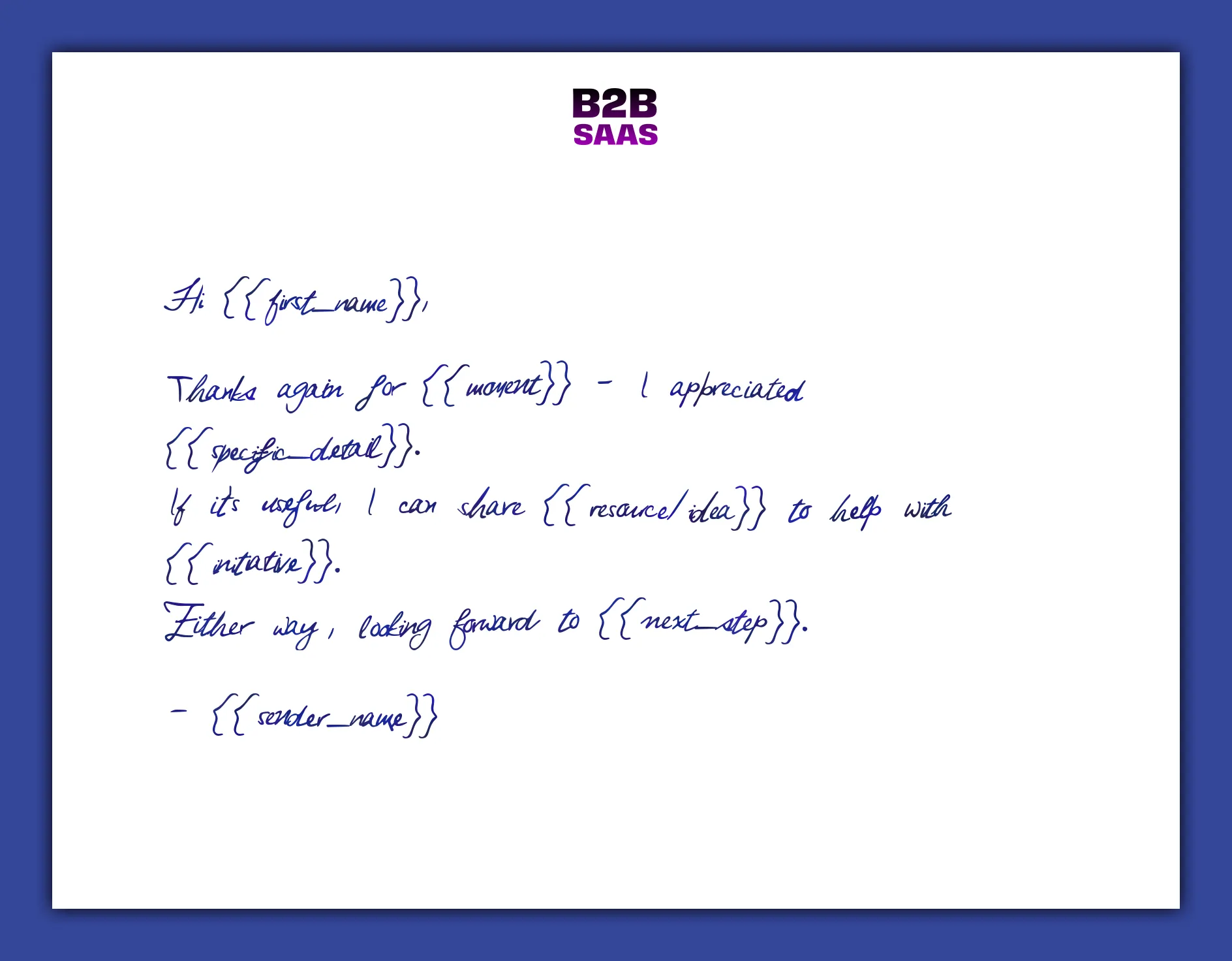
A business thank you note example
Here is the structure in one short note:
Hi {{first_name}},
Thanks again for making time to talk through {{initiative}} this week. I appreciated your point about {{specific_detail}} because it changes how we should think about {{priority}}. I will send the short plan we discussed so your team can review the next step. Appreciate the conversation and looking forward to {{next_step}}.
{{sender_name}}
For more scenario-specific examples, including prospect, customer, renewal, eCommerce retention, referral, and partner messages, see the full template library: Business Thank You Note Templates and Examples.
How to personalize without overdoing it
The best personalization is usually one line.
Use this filter:
| Personalization type | Use it? | Why |
|---|---|---|
| Something they said in a meeting | Yes | Relevant and earned |
| A milestone they shared publicly | Yes | Natural business context |
| A company initiative from the conversation | Yes | Shows listening |
| Website visits or email opens | No | Feels invasive |
| Personal life details | Usually no | Often outside the business relationship |
If the line would feel strange read aloud in a meeting, do not put it in the note.
Tone: warm, specific, and commercially restrained
A good business thank you note should feel like relationship-building, not a miniature sales page.
Use:
- plain language
- short sentences
- one concrete detail
- one useful next step
- a real sender
Avoid:
- exaggerated praise
- multiple calls to action
- pressure disguised as gratitude
- generic "valued customer" language
- non-business occasions that do not fit the relationship
The goal is not to perform emotion. The goal is to acknowledge a real contribution and make the next interaction easier.
Email vs handwritten note
Use email when speed matters or when the next step is operational.
Use handwritten mail when the relationship moment deserves more attention:
- high-value prospect meetings
- executive buyer conversations
- customer renewal or expansion milestones
- partner referrals
- stalled opportunities where trust matters more than another sequence email
Many teams use both: email for immediate follow-up, then a handwritten note for the relationship layer.
If you are building a broader sales or customer follow-up cadence, see: Direct Mail for Sales Outreach: A B2B Guide.
How to scale thank you notes without making them generic
Scaling does not mean every sentence needs to be unique. It means the right parts are fixed and the right parts are personalized.
Use a simple operating model:
- Standardize the trigger: discovery completed, renewal signed, referral made, milestone reached.
- Standardize the base message: greeting, thanks, useful next step, sign-off.
- Personalize one line: the moment, detail, or outcome that proves the note is specific.
- Track the send in the CRM: contact, account, trigger, date, sender, and follow-up outcome.
For CRM-triggered direct mail workflows, see: CRM-Triggered Direct Mail: HubSpot, Salesforce, and B2B Automation.
Common mistakes
Writing too much
Long notes usually become self-focused. Keep the message tight.
Making it about the sender
"We are excited to announce..." is not a thank you note. Lead with the recipient's action or contribution.
Asking for too much
One light next step is fine. A list of asks turns gratitude into a sales sequence.
Using fake specificity
"I loved our conversation" is still generic. Name the topic, blocker, stakeholder, or milestone.
Sending every contact the same note
Templates are useful. Generic notes are not. Add one business-specific line before sending.
FAQ
What should a business thank you note say?
It should thank the recipient for a specific business moment, mention one detail that proves the note is personal, and include a useful next step only if it helps the relationship move forward.
How long should a business thank you note be?
Four to six sentences is usually enough. If the note needs more than one paragraph, it may be trying to do too much.
Should I send a different note to a customer, client, and prospect?
Yes. A customer or client note should reinforce trust, loyalty, outcomes, or retention. A prospect note should acknowledge their time, reflect a specific business priority, and make the next step easy.
Is a handwritten thank you note better than email?
Not always. Email is better for speed. Handwritten mail is better when attention, trust, and relationship depth matter, especially with customers, clients, executives, partners, and high-value prospects.
Where can I find business thank you note examples?
Use the template hub for copy-ready examples: Business Thank You Note Templates and Examples.
Conclusion
The perfect business thank you note is not elaborate. It is timely, specific, and respectful of the relationship.
Use the 5-part structure:
- greeting
- thanks for the moment
- one specific detail
- useful next step
- real sign-off
If you need templates for common business scenarios, start here: Business Thank You Note Templates and Examples.
Want to send personalized business thank you notes at scale? Book a campaign consult