Moving-company direct mail works when it reaches the household before the move becomes chaotic.
The useful moment is a concrete signal: a home has just been listed, a seller is preparing rooms for photos and showings, a quote was requested but not booked, or a family is comparing packing, storage, and move-day help.
That is where direct mail earns its place. A good postcard or handwritten-style note gives the homeowner a calm next step before the moving company is reduced to another search result.
What makes the campaign useful
Use the mailer to make the next moving decision easier: request an estimate, reserve a crew window, add packing help, or compare local and long-distance options.
The campaign should rely on claims the mover can prove: service area, licensed and insured status, local or long-distance capability, packing services, storage availability, crew training, review proof, and actual appointment availability.
- JICMAIL 2025 Response Rate Tracker reports average planning benchmarks of 7.2% for warm direct mail, 0.9% for cold direct mail, and 0.5% for door drops. Treat these as benchmarks, not campaign promises.
- JICMAIL Q1 2024 results reported that direct mail generated 134 seconds of attention across 28 days on average. That supports useful, keepable mail, not overloaded copy.
- U.S. Census geographic mobility guidance tracks mover rates and state-to-state moves. Use local mover and listing data only where it can be licensed, matched, and used responsibly.
- USA Home Listings is a useful example of a moving-focused data and campaign partner because it connects fresh home-listing signals, contact data, vacancy filtering, and direct mail execution for moving and storage companies.
For operators, the evidence is useful for timing, list quality, CTA design, and claim review. The mailer should not imply a move date, budget, home value, vacancy status, or service eligibility unless the business has a reliable source for that field.
The 3-route moving-company mail system
Use one route for listing-led prospecting, one for move-day confidence, and one for quote and packing demand.
| Route | When to send | Primary audience | Mail format | CTA |
|---|---|---|---|---|
| New Listing Move Estimate | Fresh listing, pre-listing signal, home seller segment, vacancy-filtered record, or real estate partner workflow | Home sellers, listing households, downsizers, estate sellers, owners preparing to move | Split-panel postcard with listed-home cue and crew/truck proof; handwritten-style note for higher-intent seller leads | Get moving quote |
| Move-Day Crew Confidence | Broad local moving season, new mover planning window, local service-area prospecting, or quote education campaign | Households planning a move, local movers, families comparing crews, customers choosing between DIY and full-service help | Photo-led postcard showing crew, truck, and home entry; handwritten-style note for warm lead follow-up | Reserve move date |
| Free Quote & Packing Support | Estimate request, packing page visit, storage interest, long-distance inquiry, senior move request, or quote expiry | Quote leads, packing intenders, long-distance shoppers, senior move families, commercial or office move inquiries | Clean direct-response postcard or letter with quote-first CTA; handwritten-style note after estimate activity | Get free quote |
For the broader automation setup behind this kind of program, see CRM-triggered direct mail workflows. For measurement mechanics, use how to track direct mail marketing campaigns.
Route 1: New Listing Move Estimate
Headline: Listed your home? Start planning the move.
CTA: Get moving quote
Angle: Use listing timing to reach sellers while they are still choosing who to trust.
Listing-led mail should feel timely without feeling invasive. The homeowner has a visible moving signal, but the mailer should still be practical: estimate, packing help, crew availability, and local knowledge.

Best triggers
- Fresh home listing in the mover's service area
- Pre-listing, coming-soon, or seller-intent data where licensed
- Vacancy-filtered listing record
- Real estate partner referral
- Home sale, estate, downsizing, or relocation campaign segment
- Seller guide or moving checklist engagement
Useful data sources
- Listing data source or home-listing partner
- Vacancy or occupancy signal where licensed and reliable
- Property address and mailing address
- Service area, branch, or crew territory
- Property type and move complexity indicators
- Suppression fields for recent mail, existing quotes, and do-not-mail records
Audience segments
- Newly listed homeowners
- Sellers in high-move-volume neighborhoods
- Downsizers and estate-sale households
- Homeowners likely to need packing, storage, or larger crews
- Real estate partner referral lists
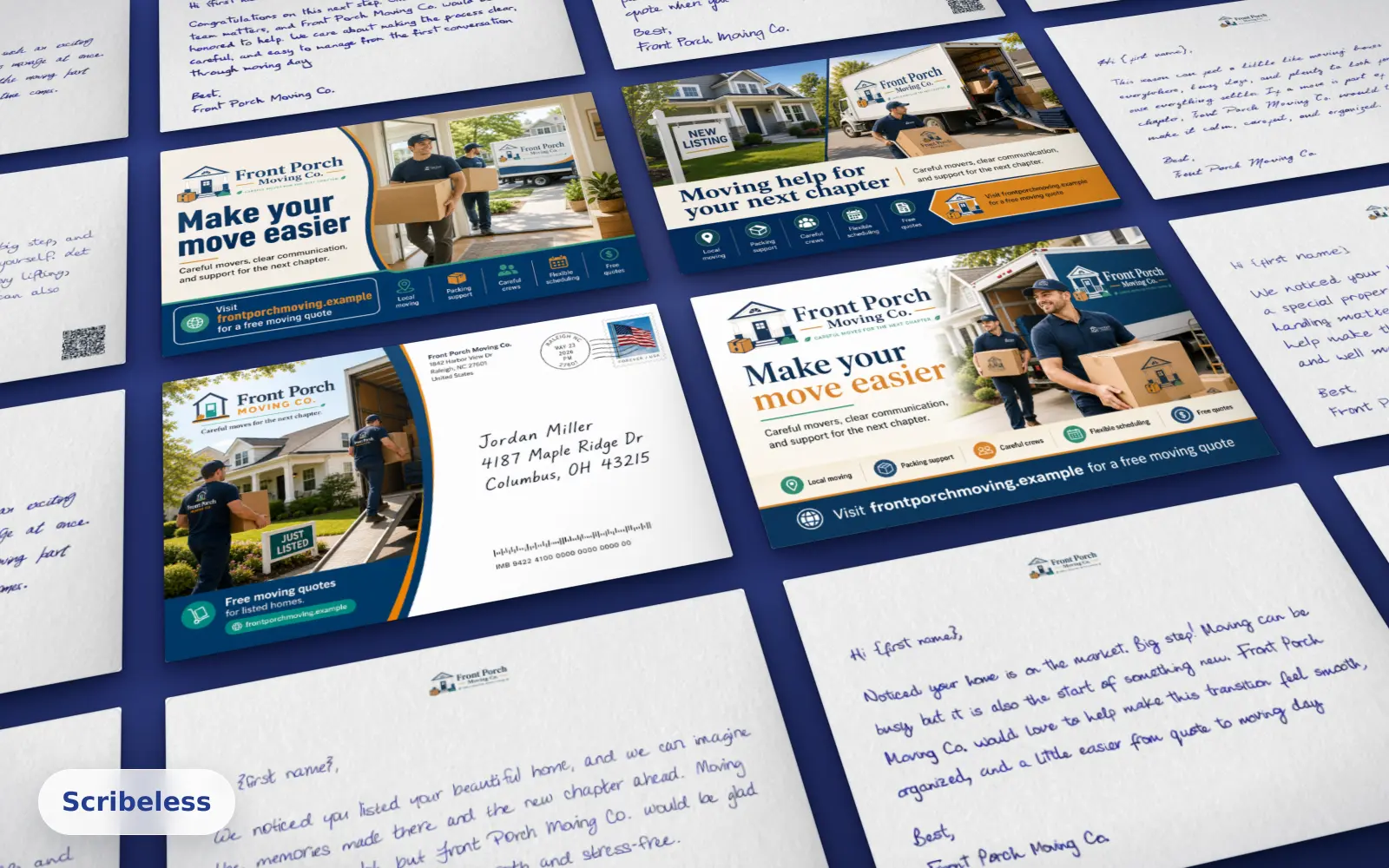
Use a postcard when the goal is broad seller reach. The strongest creative structure is a listed-home cue on one side and real moving-company proof on the other: crew, truck, service area, and a clear quote CTA.
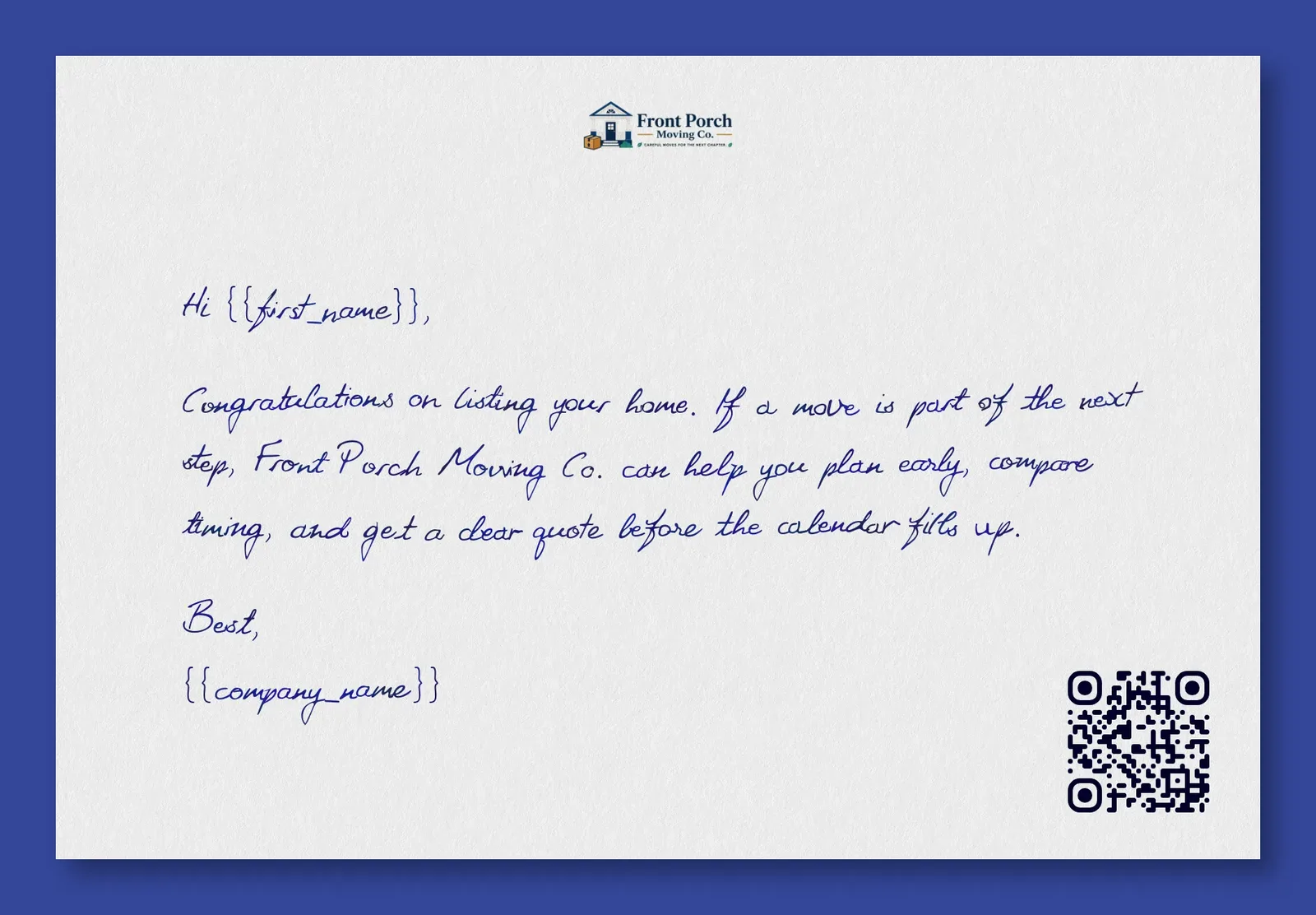
Use a handwritten-style note when the record comes from a warmer source, such as a partner referral, guide download, quote request, or repeat-customer household.
The note should congratulate the seller, offer help with timing and packing, and point to a clear quote CTA without implying the move date is confirmed.
Hi ,
Congratulations on listing your home. If a move is part of the next step, Front Porch Moving Co. can help you plan early, compare timing, and get a clear quote before the calendar fills up.
Best,
Follow-up logic
- If scanned, route to a quote form that asks move date, origin address, destination type, packing needs, and preferred contact method
- If a quote is requested, suppress from broad listing mail and move into estimator follow-up
- If the listing is withdrawn, sold, or stale, stop listing-led sends
- If the household books, suppress all prospecting and move into move-prep reminders

Partner spotlight: USA Home Listings
USA Home Listings is a strong example of the kind of partner that makes this route work. Moving companies need more than addresses. The campaign gets stronger when timing, matching, and filters help the mail reach households that are plausibly preparing for a move.
For a moving company, the useful partner workflow is:
- A fresh listing or seller-intent record enters the target service area.
- Vacancy, contact, territory, and suppression checks remove weak or inappropriate records.
- The right New Listing Move Estimate campaign is selected.
- Scribeless sends the postcard, letter, or handwritten-style note.
- QR scans and quote requests flow back to the moving company's CRM or estimator queue.
That makes USA Home Listings more than a list source. They can be part of the campaign logic: when to mail, which households to suppress, which moving-service angle to use, and how to track the quote outcome.
Route 2: Move-Day Crew Confidence
Headline: Make moving day feel handled.
CTA: Reserve move date
Angle: Sell trust in the crew, truck, process, and local service area.
Plenty of moves start outside a listing feed. Many households are comparing movers after a referral, a search, a checklist download, or a quote request. This route makes the business feel credible before the homeowner starts calling every mover in town.

Best triggers
- Peak local moving season
- Moving checklist or guide download
- Quote form started but no estimator call booked
- Referral from a real estate agent, storage company, apartment community, or relocation partner
- Prior customer referral campaign
- New service-area launch or branch expansion
Useful data sources
- Moving CRM lead stage
- Website form activity
- Call tracking and missed-call logs
- Service area and crew capacity
- Review proof and testimonial source
- Source-backed differentiators from the mover's website
Audience segments
- Local moving prospects
- Families planning a residential move
- Homeowners comparing full-service and DIY options
- Apartment or condo movers in serviceable buildings
- Warm referral leads
The creative should show the move-day reality: uniformed crew, clean truck, packed boxes, careful handling, and a home exterior. If the mover has a real branded truck or crew photo, use that over generic imagery.
Keep proof concrete. "Licensed and insured", "family-owned", "trained crews", "free quotes", "packing available", "local and long-distance moves", and review ratings are useful only when source-backed for that business.
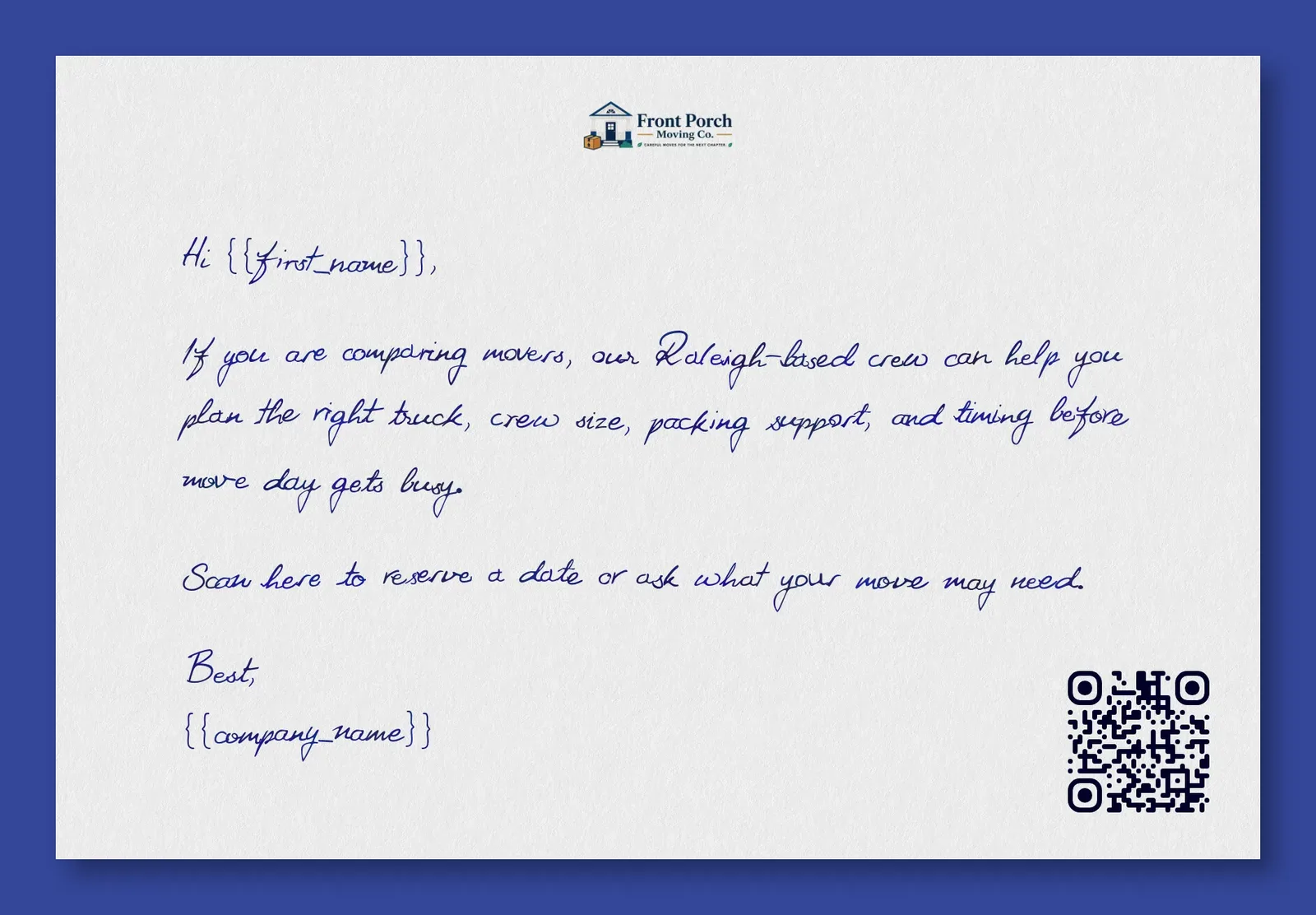
The note should make the mover feel organized and trustworthy: careful crews, clear communication, packing help, and a quote path that does not require the homeowner to know every detail yet.
Hi ,
If you are comparing movers, our Raleigh-based crew can help you plan the right truck, crew size, packing support, and timing before move day gets busy.
Scan here to reserve a date or ask what your move may need.
Best,
Follow-up logic
- If scanned, route to a quote page with crew size, date, origin, destination, and packing questions
- If a call is missed, create a callback task for the estimator or branch owner
- If no move date is supplied, ask for a planning call before requesting the full quote details
- If the move date is close and capacity is limited, suppress or change the CTA before sending
Route 3: Free Quote & Packing Support
Headline: Still comparing move options?
CTA: Get free quote
Angle: Make the quote path simple, then surface packing, storage, and specialty help where relevant.
Quote-first mail is for homeowners who need a quick path from interest to plan. It also works for warm leads who already raised a hand. The campaign should remove the next obstacle: unfinished inventory, packing uncertainty, long-distance details, elevator or building requirements, storage needs, or timing.

Best triggers
- Estimate requested but not booked
- Quote sent but not accepted
- Packing page or storage page visited
- Long-distance or interstate move inquiry
- Senior move, piano move, white-glove, or commercial move request
- Quote expiry or incomplete inventory form
Useful data sources
- Quote status and quote expiry date
- Move type: local, long-distance, packing, storage, commercial, senior, piano, or white-glove
- Estimator owner or branch
- Service-area and capacity status
- Contact permission for digital follow-up
- Suppression status after booking, decline, or lost quote
Audience segments
- Quote leads who did not book
- Packing and storage intenders
- Long-distance move shoppers
- Senior or white-glove move families
- Commercial or office move inquiries
Use direct-response postcards when the quote can start online. Use letters or handwritten-style notes when the move is complex and a conversation is more useful than a form.
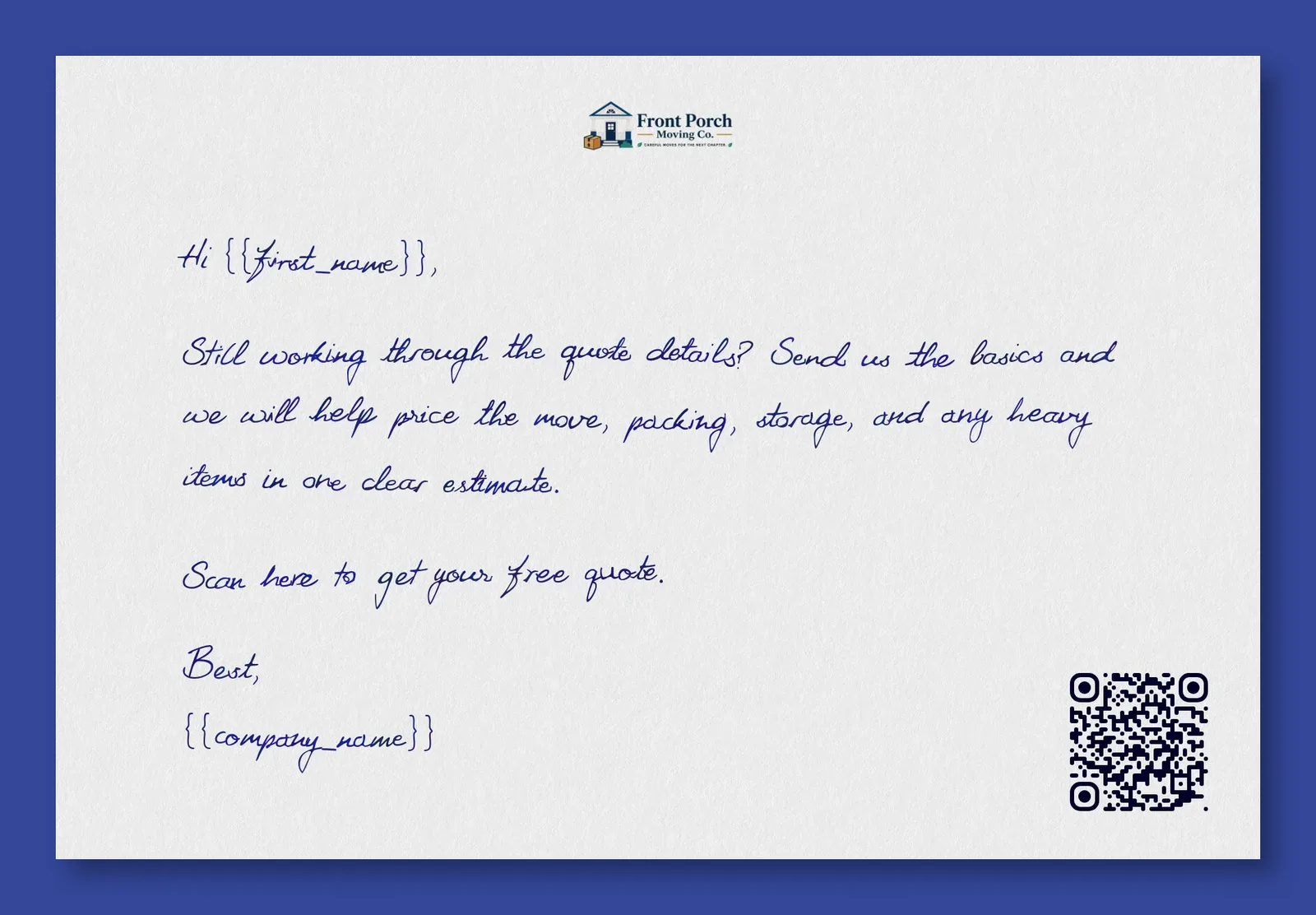
The note should keep the ask simple: scan for a free quote, then let the estimator handle packing, storage, crew size, and schedule details.
Hi ,
Still working through the quote details? Send us the basics and we will help price the move, packing, storage, and any heavy items in one clear estimate.
Scan here to get your free quote.
Best,
Follow-up logic
- If scanned, open the quote path and show the next missing step if a quote record already exists
- If the lead asks about packing, route to a packing add-on estimate or coordinator task
- If the quote is accepted, suppress all quote-recovery mail
- If the lead declines, log the reason and suppress for a defined period
- If the move date has passed, stop move-day CTAs and consider a review or referral campaign instead
Build the moving data model before scaling
Moving campaigns are only useful when the trigger, service area, and capacity fields agree. Before sending, define the fields that decide whether a household should receive a listing-led postcard, a crew-confidence mailer, or a quote follow-up.
Minimum fields:
- First name and last name.
- Full postal address and country.
- Property address if different from mailing address.
- Customer, prospect, referral, or partner-source status.
- Service area, branch, crew territory, postcode sector, or ZIP cluster.
- Route assignment: New Listing Move Estimate, Move-Day Crew Confidence, or Free Quote & Packing Support.
- CTA destination and QR campaign source.
- Source platform and source record ID.
- Do-not-mail and suppression flags.
- Last mail sent date.
Add these moving-specific fields when they are reliable:
listing_statuslisting_datevacancy_statusproperty_typemove_stagemove_typequote_statusmove_datepacking_intereststorage_interestestimator_ownerbranch_capacity_status
Use optional fields carefully:
home_value_bandbedroom_countdistance_bandsenior_move_interestpiano_or_specialty_item_flagcommercial_move_flagreview_proof_source
Do not turn free-text notes into visible personalization. "Packing requested" or "long-distance quote started" can help route the campaign. The mailer itself should stay simple unless the recipient gave the business permission to use that context.
Automation recipe: from listing or quote signal to mail to QR follow-up
Moving automation should start from a real moment: a listing goes live, a quote stalls, a packing-service page is visited, or a partner sends a qualified referral.
Create the Scribeless campaign first with approved creative, route-specific CTA, safe merge variables, and suppression rules. Then let the moving CRM, USA Home Listings workflow, call tracking tool, or quote platform add only eligible records.
The key is to stop mail when the move context changes. If the home is no longer listed, the quote is accepted, the move date has passed, or the branch has no crew capacity, the campaign should pause or switch route.
Workflow A: create recipients
| Step | Moving-company example |
|---|---|
| Trigger | USA Home Listings adds a fresh listing record, the moving CRM updates quote status, a quote form is abandoned, or a packing/storage page creates a lead |
| Filter | Continue only if the address is complete, the household is in service area, the route matches, branch capacity is available, and the recipient is not suppressed |
| Delay | For listing-led mail, send early in the listing window. For quote follow-up, wait until the estimator has had time to call or send the first quote |
| Scribeless action | Use Zapier's Scribeless Add Recipients action, a Make scenario, or an API workflow to add the record to the right moving campaign |
| Log back | Write campaign route, send date, source record, QR source, and template ID back to the moving CRM or partner workflow |
Workflow B: react to QR scans
| QR scan from | Follow-up action |
|---|---|
| New Listing Move Estimate mailer | Create an estimate task with listing source, service territory, and seller timing attached |
| Move-Day Crew Confidence mailer | Route to a quote scheduler or branch callback with crew-capacity status visible |
| Free Quote & Packing Support mailer | Open or reopen the quote, assign the estimator, and show the missing step: inventory, packing, storage, date, or destination |
Treat a QR scan as an operational task. Zapier can update the moving CRM, notify the estimator, and suppress the recipient from duplicate mail. Make, Scribeless Advanced Flows, or the CRM API can handle custom partner-source checks, branch capacity, and quote-stage routing.
Field mapping checklist
| Scribeless/source field | Why it matters |
|---|---|
first_name, last_name | Salutation, dedupe, and quote-record matching |
address_line_1, address_line_2, city, postcode, country | Deliverability and service-area routing |
property_address | Separates listed property from mailing/contact address |
customer_status | Prevents active customers and booked moves from receiving prospecting mail |
campaign_route | Selects listing, crew-confidence, or free-quote creative |
source_platform, source_record_id | Reconciles the send back to USA Home Listings, the moving CRM, quote tool, or partner workflow |
qr_destination | Sends the recipient to the right estimate, scheduler, quote, or packing add-on path |
suppression_status, last_mail_sent_at | Controls frequency and stops duplicate mail |
listing_status, listing_date | Keeps listing-led mail inside the useful seller window |
vacancy_status | Helps prioritize records when the source is licensed and reliable |
move_stage, move_date | Prevents stale move-day CTAs and helps route urgent callbacks |
move_type | Routes local, long-distance, packing, storage, senior, piano, or commercial inquiries |
quote_status | Decides whether the record needs first quote, quote recovery, or suppression |
packing_interest, storage_interest | Routes add-on follow-up without exposing too much in visible copy |
estimator_owner, branch_capacity_status | Sends scans to the right person and avoids demand the team cannot serve |
review_proof_source | Keeps ratings, review counts, and testimonials source-backed |
Partner and integration ideas
Moving partners are most valuable when they know timing, service area, quote status, or move complexity. The campaign should use that context to choose the right next step while keeping visible personalization restrained.
| Partner type | Who they serve | Trigger or data they own | How Scribeless could plug in | Useful partner angle |
|---|---|---|---|---|
| Listing and move-intent data partners such as USA Home Listings | Moving and storage companies targeting active home sellers | Fresh listing record, contact data, vacancy filter, service-area match | Send New Listing Move Estimate mailers and route QR scans into estimator follow-up | Co-marketing guide on listing-triggered direct mail for movers |
| Moving CRMs, quote tools, and call tracking systems | Moving-company owners, sales teams, estimators, and dispatchers | Quote requested, quote sent, call missed, move date, estimator owner, branch capacity | Trigger quote follow-up, crew-confidence mail, and QR scan tasks | Support doc for recovering stalled moving quotes with mail |
| Real estate, storage, relocation, and property partners | Agents, brokerages, apartment communities, storage operators, relocation services | Seller referral, move-in or move-out window, storage need, relocation plan | Send partner-branded moving or packing follow-up and track source outcomes | Referral nurture kit for moving partners |
| Review and reputation platforms | Movers with review volume and testimonial proof | Review rating, testimonial, review source, service-area reputation | Use approved review proof in mail and suppress unsupported claims | Proof-safe campaign templates for moving companies |
A simple first workflow starts with fresh listing records:
- Create the New Listing Move Estimate campaign in Scribeless with a listing-aware headline, quote CTA, and only source-backed proof.
- Use USA Home Listings or another licensed source to identify fresh listing records inside the mover's service area.
- Filter for complete postal address, serviceable territory, vacancy or seller-context rules where used, branch capacity, and no recent moving mail.
- Add recipients to Scribeless with fields such as
listing_status,listing_date,property_address,move_stage,source_record_id, andcampaign_route. - On QR scan, create an estimate task, notify the estimator or branch owner, and tag the record as
mail_engaged_new_listing_move_estimate. - Suppress if the quote is booked, the home is no longer active, the recipient declines, or the move window becomes stale.
Before you mail
Before a campaign sends, check:
- Address is complete and valid enough for the target country.
- Listing, mover, or partner data is licensed for the intended outreach.
- Service area and branch capacity match the recipient's location.
- Suppression, opt-out, and do-not-mail rules are respected.
- The CTA destination exists and matches the route.
- QR codes, phone numbers, quote forms, and booking links are tested.
- Merge variables cannot render blank.
- The source system receives the send log and QR engagement.
- Claim chips such as "licensed and insured", "free quote", "packing available", "storage available", "local and long-distance", "trained crews", "family-owned", or review ratings are useful when true. Verify them for the specific mover, branch, service area, and offer before live use.
- Do not invent review counts, ratings, license status, insurance, availability, crew size, storage capacity, long-distance capability, packing services, or specialty moving services.
- Do not imply the household has a confirmed move date, vacancy status, or budget unless the business has a reliable, allowed source.
- Stop sends when listings go stale, move dates pass, or crew capacity changes.
Measurement plan
Track the program by route and source, with total mail volume as the baseline.
Minimum events:
- Mail queued.
- Mail sent.
- QR scanned or trackable URL visited.
- Quote started.
- Quote completed.
- Estimator callback created.
- Move date requested.
- Booking won, lost, deferred, or referred out.
- Add-on interest captured for packing, storage, long-distance, senior, piano, or commercial moving.
- Suppressed because the recipient booked, declined, opted out, received recent mail, or the move/listing window expired.
Route-level reporting should answer different questions:
- New Listing Move Estimate: which listing sources, vacancy filters, territories, and property segments create quote requests?
- Move-Day Crew Confidence: which service-area and proof combinations create booked estimator calls?
- Free Quote & Packing Support: which quote CTAs, stalled quote stages, and add-on interests recover revenue?
Where volume allows, use holdout groups. Keep comparable listing or quote segments unmailed so the team can estimate incremental quote lift instead of assuming every booking came from mail.
A simple first campaign
For a first moving-company campaign:
- Pick one service area with real crew capacity.
- Use a fresh listing source such as USA Home Listings for the New Listing Move Estimate route.
- Send postcards to listing-led prospects and handwritten-style notes to warmer quote or referral records.
- Use one quote landing page per route.
- Track quote requests, estimator callbacks, booked moves, quote value, add-on revenue, and suppression accuracy.
That is enough variation to learn whether fresh listing timing, crew-confidence messaging, or free-quote follow-up creates the strongest booked move pipeline.
Final takeaway
Moving-company direct mail works best when it is tied to a real moving signal: a home listing, a quote request, a packing need, or a service-area opportunity.
The useful system is the handoff from source-backed data to campaign route, quote CTA, estimator task, and suppression when the move context changes.
Want to build a moving-company direct mail workflow around listing leads, move-day confidence, or free quote follow-up? Book a campaign consult.