Introduction: retention is won in moments, not reminders
B2B retention isn’t decided by a single renewal email.
It’s decided by a sequence of moments:
- whether onboarding felt supported
- whether your champion felt understood
- whether value was visible to stakeholders
- whether the relationship had enough trust to survive a bump
Direct mail is powerful in retention because it:
- lands outside the “automated lifecycle” noise
- signals care and effort
- reaches exec sponsors who don’t live in the CS inbox
This guide is a B2B retention playbook: when to send mail, what to send, what to say, and how to measure impact.
For a broader B2B prospecting context, see: How direct mail makes an impact for B2B sales.
Where retention mail fits in the lifecycle (B2B)
Think in stages:
- Onboarding (0–90 days)
- Adoption + value realization (ongoing)
- Renewal window (60–120 days before renewal)
- Expansion moments (intent signals)
- Risk moments (usage drop, champion churn, budget pressure)
Direct mail works best when it’s connected to a trigger, not a calendar.
If those retention triggers live in HubSpot or Salesforce, the CRM-triggered direct mail workflow guide shows the field model, suppression rules, and owner tasks to add before scaling.
The 8 highest-leverage triggers for retention mail
1) Go-live / first value achieved
Purpose: reinforce confidence and reduce early churn risk.
2) Exec sponsor introduced (or reintroduced)
Purpose: build relationship equity at the top of the account.
3) NPS/CSAT promoter response
Purpose: convert goodwill into advocacy (reviews, referrals, case studies).
4) Renewal window opens (90/60/30-day milestones)
Purpose: keep renewal from becoming a last-minute scramble.
5) Usage drop or adoption risk
Purpose: signal support and re-engage stakeholders.
6) Champion job change / promotion
Purpose: protect your “path” inside the account.
7) Expansion intent signal
Purpose: accelerate growth when the account is receptive.
8) “Quiet account” pattern (no engagement despite usage)
Purpose: re-humanize the relationship and reopen communication.
If you’re building multi-touch cadence (mail + email + calls), this is a useful companion: Using Direct Mail with Multi-Touch Campaigns & Optimizing ABM Cadence.
What to send: format selection for retention
Retention programs work best with a simple tiering model:
Tier 1: strategic accounts (high ACV / high risk)
- handwritten letter or note from CS leader / exec sponsor
- higher quality stationery or a folded card
Tier 2: mid-market accounts
- handwritten note triggered by milestones
- occasional printed reach mail when appropriate
Tier 3: long-tail accounts
- only send mail on high-signal moments (promoter, expansion intent, renewal risk)
If you want a broader framing on handwritten vs print, see: The ultimate guide to handwritten marketing.
What to write: retention note frameworks (with templates)
Retention notes should do one of three things:
- reinforce value
- reinforce partnership
- reduce uncertainty (especially for exec sponsors)
Template 1: onboarding milestone (first value)
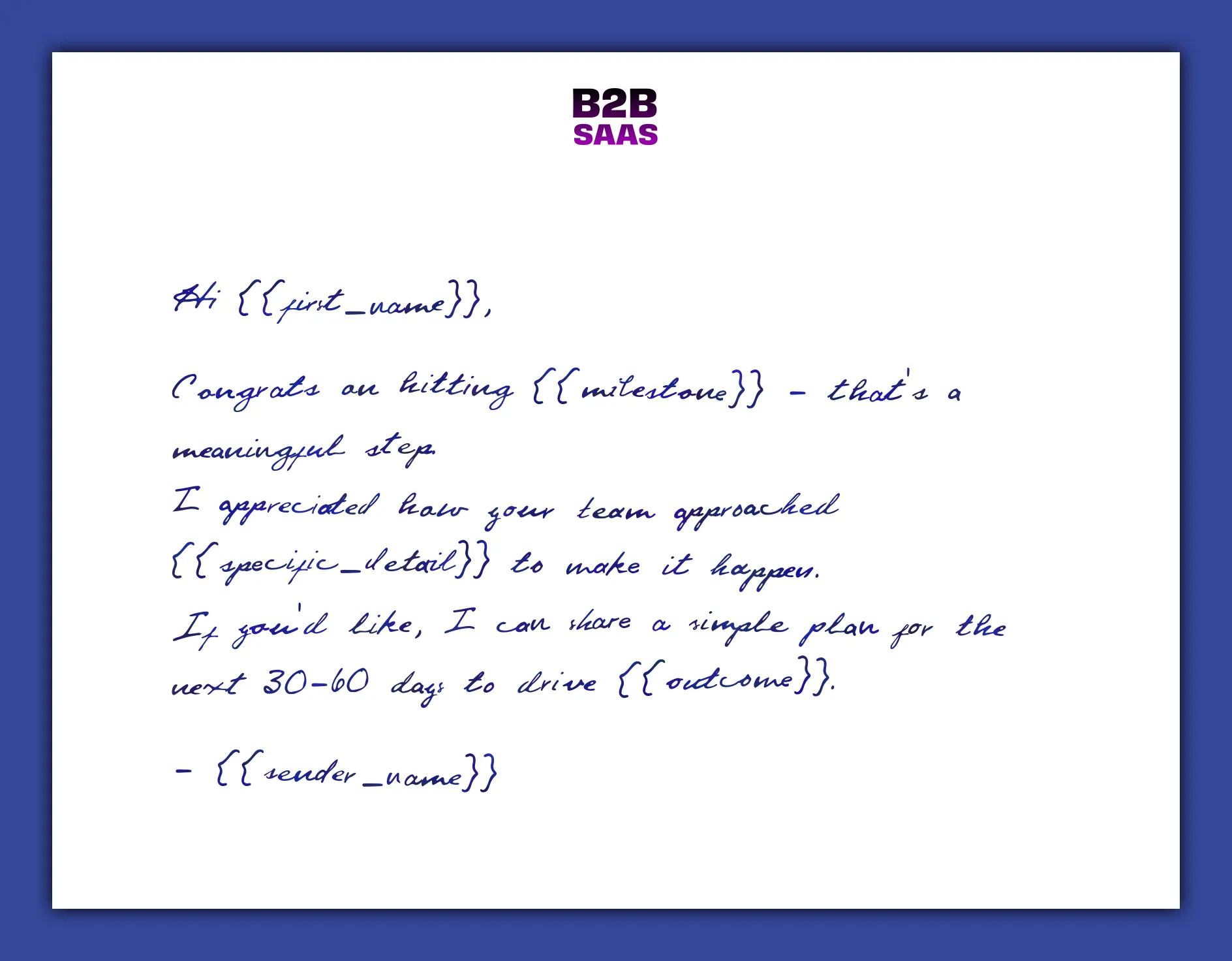
Hi {{first_name}}, Congrats on hitting {{milestone}} — that’s a meaningful step. I appreciated how your team approached {{specific_detail}} to make it happen. If you’d like, I can share a simple plan for the next 30–60 days to drive {{outcome}}. — {{sender_name}}
Template 2: renewal window (90 days out)
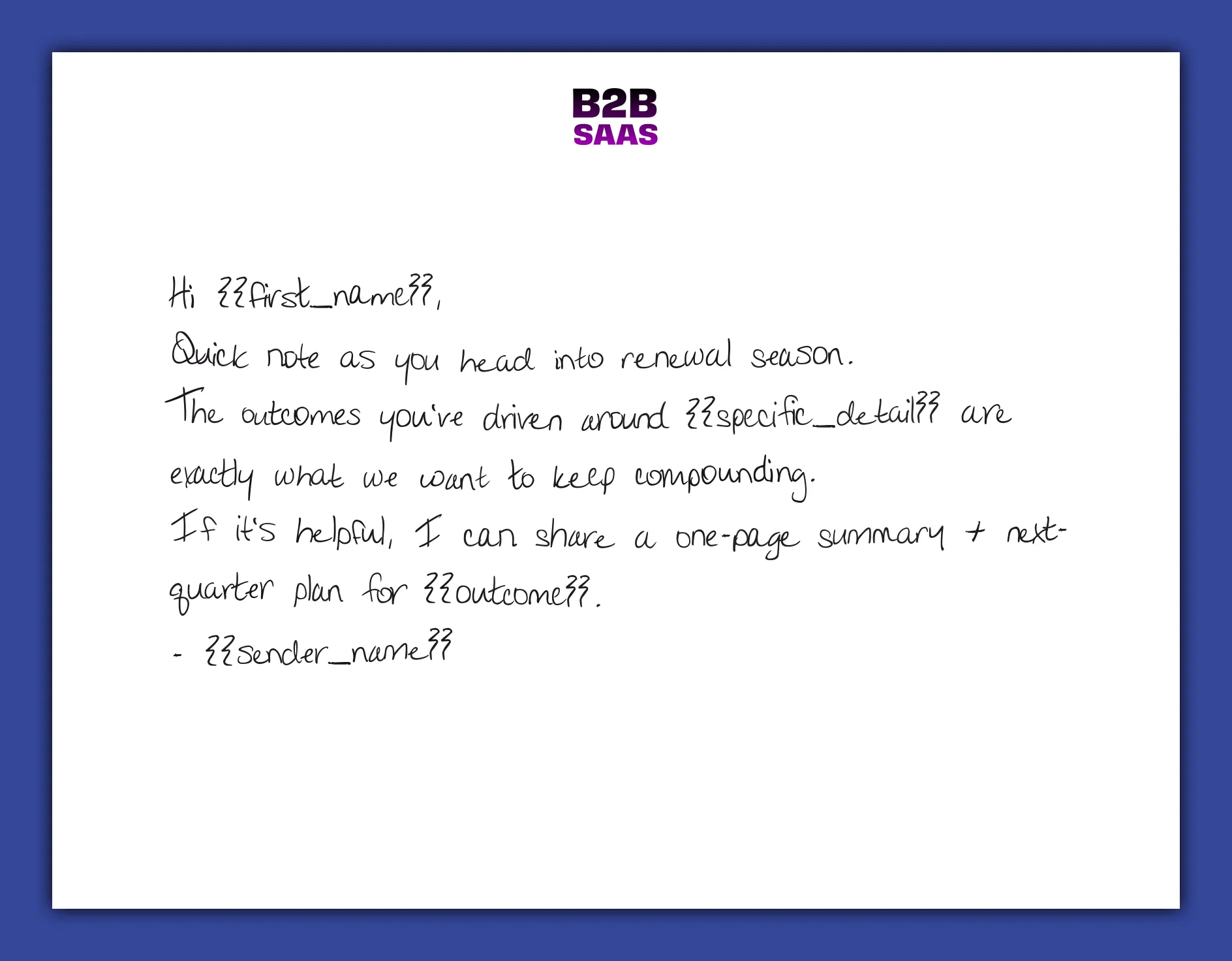
Hi {{first_name}}, Quick note as you head into renewal season. The outcomes you’ve driven around {{specific_detail}} are exactly what we want to keep compounding. If it’s helpful, I can share a one-page summary + next-quarter plan for {{outcome}}. — {{sender_name}}
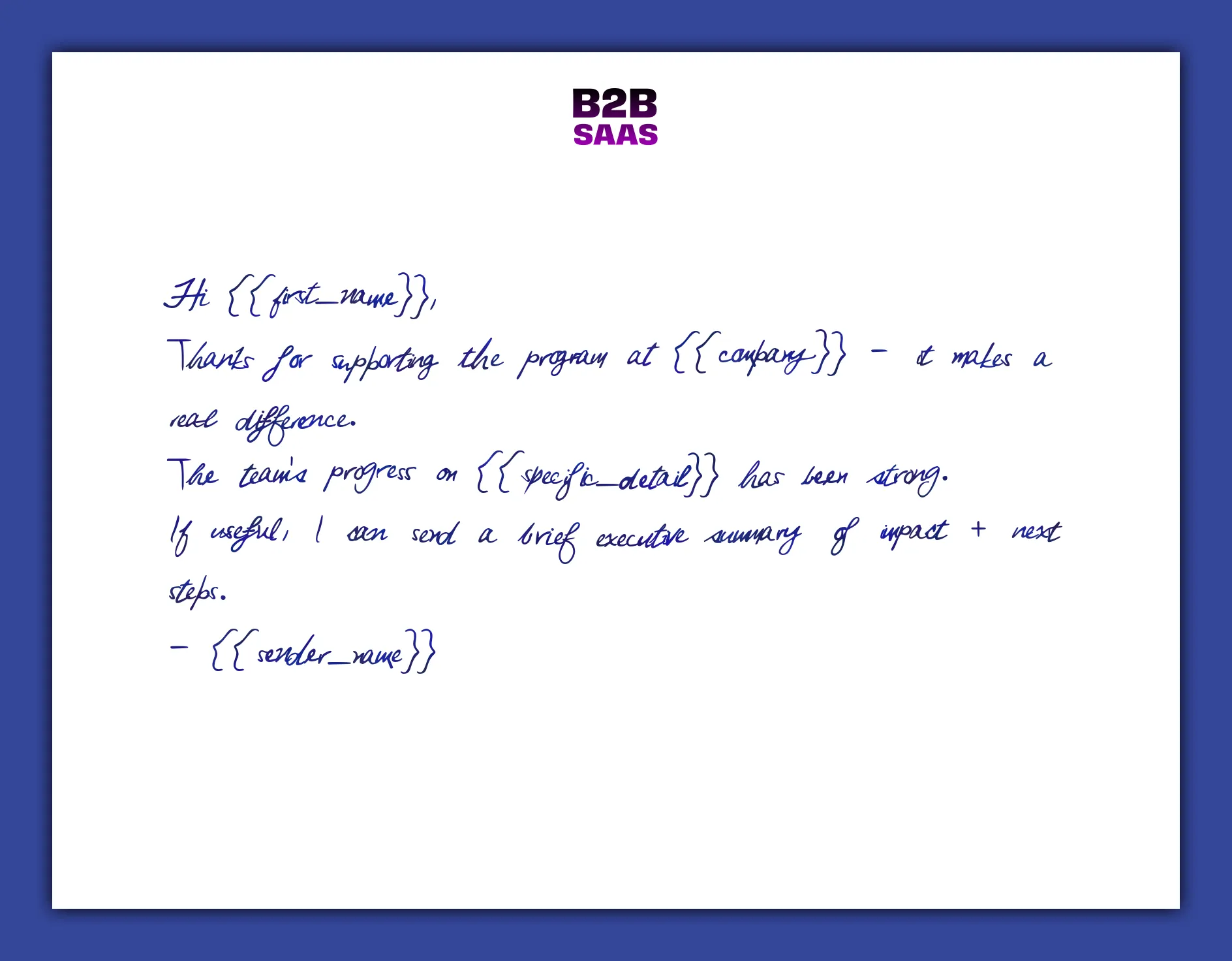
Template 3: exec sponsor reinforcement
Hi {{first_name}}, Thanks for supporting the program at {{company}} — it makes a real difference. The team’s progress on {{specific_detail}} has been strong. If useful, I can send a brief executive summary of impact + next steps. — {{sender_name}}
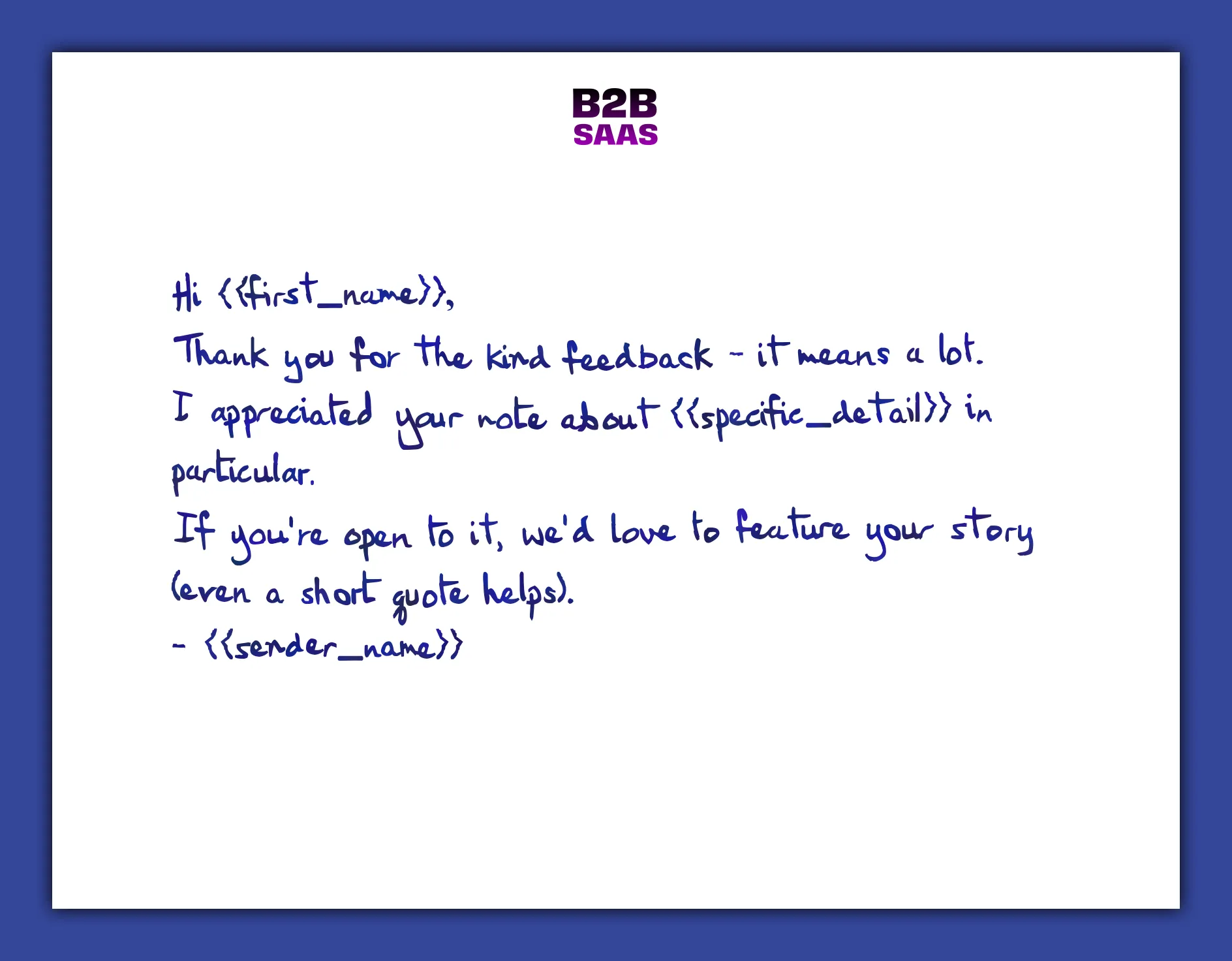
Template 4: promoter → advocacy
Hi {{first_name}}, Thank you for the kind feedback — it means a lot. I appreciated your note about {{specific_detail}} in particular. If you’re open to it, we’d love to feature your story (even a short quote helps). — {{sender_name}}
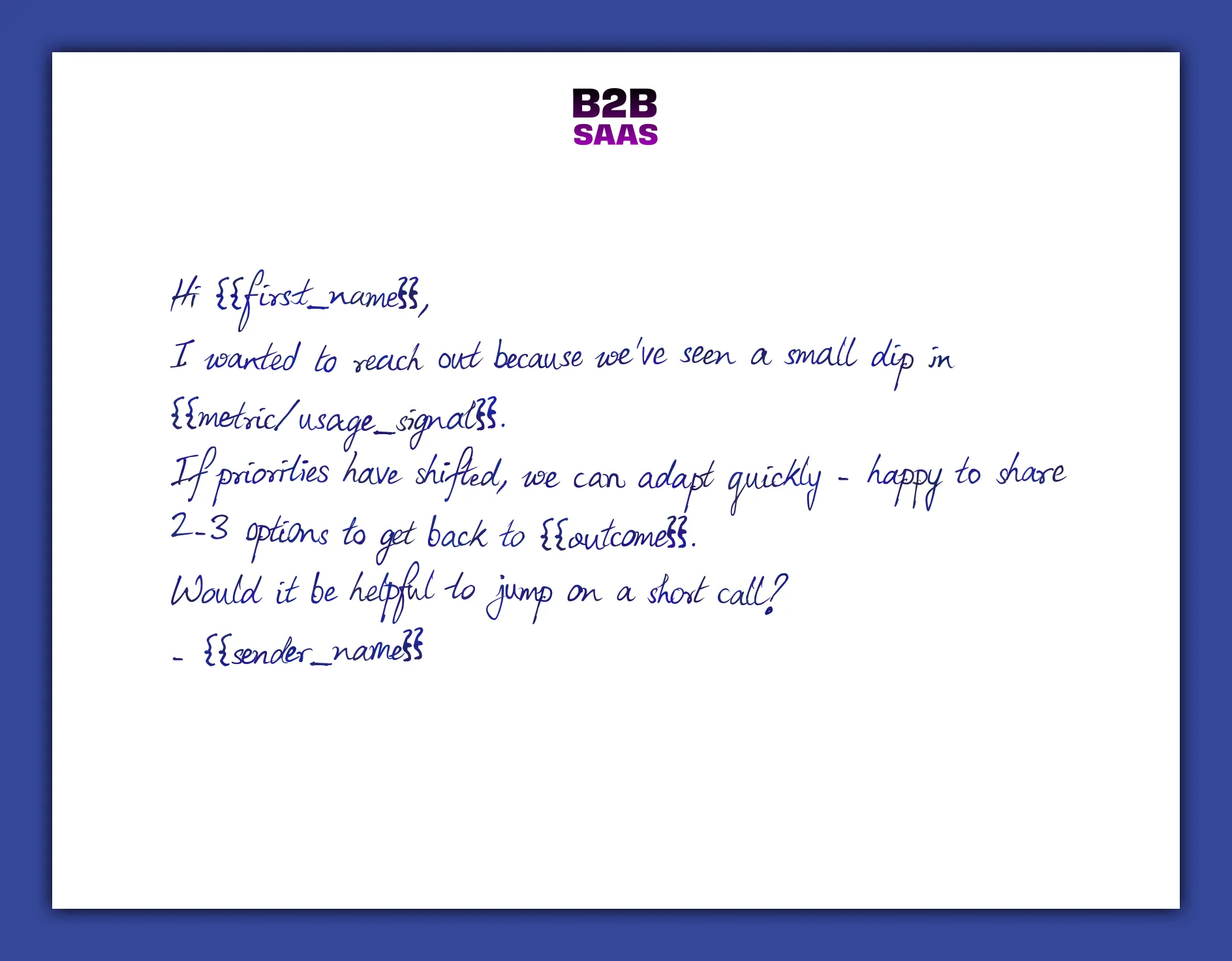
Template 5: usage drop / risk moment
Hi {{first_name}}, I wanted to reach out because we’ve seen a small dip in {{metric/usage_signal}}. If priorities have shifted, we can adapt quickly — happy to share 2–3 options to get back to {{outcome}}. Would it be helpful to jump on a short call? — {{sender_name}}
If you want “thank you” notes specifically (customers, champions, partners), see: Business Thank You Notes: Templates for Clients, Prospects & Partners.
How to operationalize retention mail (without adding chaos)
1) Map triggers to ownership
- CS owns onboarding, adoption, renewal
- RevOps owns instrumentation and workflow reliability
- Exec sponsor owns Tier 1 sponsor notes
2) Define frequency caps
Retention mail should feel intentional. Typical guardrail:
- max 1 touch per contact per month
- higher for Tier 1 during renewal windows
3) Build templates with “one-line personalization”
Keep 80% consistent, 20% variable:
- {{milestone}}
- {{specific_detail}}
- {{outcome}}
4) Add measurement before scaling
At minimum:
- record “mail sent date” in CRM
- use a trackable URL/QR for any CTA
For tracking basics, see: How to track direct mail marketing campaigns.
How to measure retention mail (what matters)
Retention outcomes are rarely last-click attributable. Measure in layers:
- renewal rate lift (by segment)
- expansion rate lift (by segment)
- adoption metrics (time-to-value, active users, feature usage)
- qualitative signals (exec sponsor engagement, reply rate, QBR attendance)
If you can, use a holdout group for incremental lift:
- hold out a random subset of accounts from mail
- compare renewal/expansion outcomes after an attribution window
Conclusion
Retention mail isn’t about “sending something nice.”
It’s about building a program that:
- shows up at the right moments
- reinforces value and partnership
- and is measured like a serious growth lever
Want help building a retention mail program (triggers, templates, measurement)? Book a campaign consult